Golfers at Royal Dornoch expecting a quiet round on Tuesday (28 April) were met with chants, megaphones and a protest against caged eggs on Britain’s supermarket shelves.

The disruption, led by animal welfare campaigners The Humane League UK at a Farmfoods-sponsored event this week, has thrown fresh light on an uncomfortable reality for the grocery sector. While most major retailers have moved away from caged eggs, millions of hens in the UK are still confined in cages, and some parts of the supply chain continue to rely on them.
New government figures due this week are expected to show that eggs from caged hens are at an all-time low. Campaigners say that this is progress worth noting, but they also warn that it risks masking a deeper issue and lulling the sector into a false sense of security: the pace of change is uneven, and without legislation and every supermarket committing, it may stall.
Progress made, but millions remain
“There has been amazing momentum,” says The Humane League UK campaigner Laurie Wills. “Most supermarkets are progressing and meeting their cage-free commitments, and government support for a ban is incredibly exciting.”
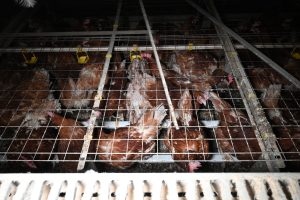
But she points to the scale of what remains: “7.3 million hens are still in cages today. And some companies are refusing to end cages altogether.”
A decade ago, around half of UK hens were kept in cages. That figure has fallen sharply, largely driven by retailer commitments and shifting consumer expectations, yet The Humane League has warned that progress is now slowing as the industry reaches its most difficult segment.
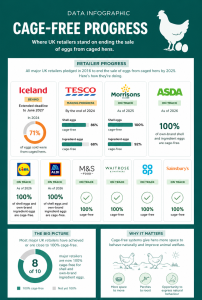
Among major retailers, Farmfoods has become the focal point. Campaigners describe it as the clear outlier, noting that it has not committed to phasing out caged eggs, even as competitors move ahead.
Across the market, progress has been uneven. Marks & Spencer, Waitrose, Co-op and Sainsbury’s have already eliminated cages entirely.
Recent to join them, Aldi, Lidl and Asda are now fully cage-free for own-brand shell and ingredient eggs. Morrisons has removed cages from all shell eggs and the majority of ingredient eggs.
Tesco has made significant progress, though it still relies on caged supply for part of its ingredient range. Iceland has reinstated a cage-free commitment for 2027, after protests by The Humane League last year, but as recently as 2024, 71 per cent of its eggs were still from caged hens.
So, as Wills says, the direction of travel is clear and positive, but still leaves campaigners questioning how long until the practise is completely scrapped.
Price and the limits of voluntary action
Willis says retailers often argue that cost remains a barrier. Caged eggs are cheaper to produce, allowing supermarkets to maintain lower shelf prices during a prolonged cost-of-living squeeze.
Farmfood’s eggs policy says it is unable to source non-caged eggs in volume due to their price, adding the supermarket wanted to continue “offering everyday great value and are unwilling to deny customers access to the good value, nutritious food provided by eggs laid by caged hens.”
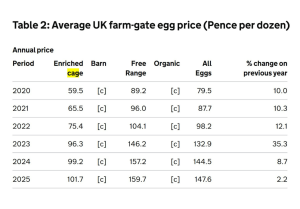
However, the Humane League disputes that argument. It estimates that a dozen cage-free eggs costs around 159.7p to produce, compared with 101.7p for caged eggs.
“It’s not a significant difference,” Wills says. “It feels like an excuse by corporations to make a tidy profit. It’s a small price to pay, but it makes a huge difference to animal welfare.”
And recent research from the University of Reading suggests many consumers are willing to pay more for higher welfare products, adding further pressure on retailers’ claims.
Campaigners also point to the example of discount chains. Aldi and Lidl have moved to fully cage-free supply without abandoning their value positioning, raising questions about why others have not followed.
Meanwhile, an investigation by The Humane League claims it found Farmfoods selling eggs from caged hens at the same price as Aldi’s free-range eggs
For Wills, the issue ultimately comes down to trust. “If you were stuck in a crowded lift for your entire life, would you want to wait for legislation, or would you want the company to get you out as soon as possible?”
She points to past commitments that have slipped. Farmfoods pledged in 2016 to move away from caged eggs following campaigning pressure, but later dropped that pledge. Attempts by The Humane League to re-engage the retailer, including direct outreach to its owners, were met with silence.
“That’s why we can’t rely on voluntary commitments alone,” she says. “We need legislation to hold the laggards to account.”
Why the endgame is proving harder
The government is now considering a ban on “enriched colony cages” by 2032, a timeline that reflects both political caution and the realities of supply chain change.
Wills acknowledges that ministers are likely trying to balance animal welfare with the need to give farmers time to adapt.
“This is something that needs proper planning and management,” he says. “But we believe this could be achievable. The sooner the better.”
The challenge lies partly at farm level. Many producers invested heavily in enriched cage systems following the 2012 ban on conventional battery cages and are still recouping those costs. At the same time, more than 80 per cent of UK egg production is already cage-free, suggesting the transition is well underway.
Government grants of up to £500,000 are available to support farmers switching systems, and campaigners stress that the push for a ban is not aimed at producers.
Alongside this sits a broader concern about imports. Industry groups have warned that banning cages in the UK could lead to lower-welfare eggs entering the market from abroad.
However the Humane League argues that risk is overstated, pointing out that the UK is around 89 per cent self-sufficient in eggs and that countries such as Germany and Austria have already implemented bans.
Perhaps the most complex issue lies beyond the supermarket shelf. While many retailers have cleaned up their shell egg supply, caged eggs can still be used in ingredients across ready meals, bakery and food-to-go. Data in this area is limited and often based on self-reporting, making it harder to track progress.
“That is a worry,” Wills says. “NGOs don’t have the capacity to monitor everything. That’s why a ban matters. It would remove the problem across the entire system.”
For now, the direction is set. Caged eggs are declining and public pressure is growing. However, these final stages of the transition is proving the most difficult, shaped by cost pressures and uneven commitments across the sector.
“The numbers suggest the end is coming,” says Wills. “But without action, millions of hens will still be left behind.”
Farmfoods has been contacted for comment.
Click here to sign up to Retail Gazette‘s free daily email newsletter