With budgets tightening across the business world, marketing is often under pressure to do more with less. But what if a brand could pay for part of a campaign without paying entirely in cash?
That is the thinking behind Havas’ brand-to-brand partnership model, which encourages companies to look at what they already have, from products and excess stock to media space, audiences and brand credibility, and use those assets as a form of currency.
David Pickles, EVP of Loyalty and Partnerships at Havas Market UK, has spent decades working in brand partnerships and says the idea is becoming increasingly relevant as marketing teams face tighter budgets.
“The only sensible way for every brand to materially benefit is to collaborate, is to start to trade,” he says. “To get back to old-fashioned barter. And I don’t mean media barter, I mean swapping shoes for pens.”
Turning excess stock into marketing gold
The proposition is not simply about brands swapping advertising space. Pickles says it can also provide a way for companies to deal with practical business problems, including excess inventory.
One example involved a major chocolate manufacturer with five container lorries of luxury chocolate that was approaching its use-by date. Rather than sending it for disposal, Havas helped arrange for boxes to be given to teachers at the end of term.
The arrangement saved the manufacturer about £150,000 in costs associated with reprocessing the chocolate, according to Pickles, while also helping it with its sustainability objectives.
There was another commercial benefit. The organisation distributing the chocolate subsequently became a customer of the manufacturer.
“That’s the kind of thing that you can do,” Pickles says. “It can be about clearing excess inventory. It can be about driving sampling agendas. It’s super creative.”
The same thinking has been applied to other products. Pickles recalls deals involving surplus bottled water being supplied to airlines and events, including a long-running arrangement with Festival Republic, now part of Live Nation.
In one case, surplus water became part of an event sponsorship and generated unexpected publicity, including a magazine feature involving Lily Allen. The model can also be used when products cannot easily be sold through normal retail channels. Pickles says Havas has worked with products carrying unclear or smudged date stamps which could not be sold to consumers, but could still be used as service items on planes or trains where the correct date could be verified.
“The stock doesn’t have to be binned,” he says. “It can actually be reused.”
The same principle applies to marketing assets. Pickles points to retail media as an example, arguing that brands increasingly have valuable assets beyond their traditional advertising budgets.
“Every brand is a nascent retail media network,” he says, pointing to on-pack opportunities, distribution, reach and the audiences brands can access.
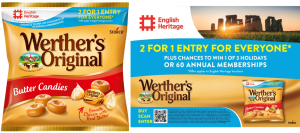
Havas says its team speaks to close to 1,000 brands a month in the UK and operates across around 35 markets. The role is to find where the needs and assets of two businesses can match. A recent example is the partnership between Werther’s Original and English Heritage. Pickles says the team considered around 40 to 50 potential partners before settling on English Heritage, with both sides bringing something valuable to the arrangement.
The wider Havas proposition has been built around brand collaborations for years, with Pickles pointing to work with PepsiCo as an example. Past campaigns have included crisps using flavours associated with brands such as Nando’s and PizzaExpress, while a Walkers promotion involving Lastminute.com generated 11.7 per cent sales growth, according to Pickles. The numbers, however, are not always the point.
‘It is not a free lunch’
The biggest misunderstanding, Pickles says, is that value-in-kind partnerships are simply a way of getting something for free.
“Some organisations think that it’s about getting stuff for free but not giving anything in return,” he says. “This is about reciprocal mutual benefit value exchange rather than a free lunch.”
Havas uses what Pickles calls a “balance of exchange” process to assess what each side is bringing to the partnership. The values do not always have to match financially. A smaller brand, for example, might value access to a much larger audience, while a major brand might value the credibility or cultural relevance of partnering with a specialist business.
Cash can still be involved. In some cases, a smaller partner may need financial support, while larger campaigns may require insurance or other arrangements to manage the value being exchanged.
“Cash is just one of the assets,” Pickles says. “It’s not the principal asset in any kind of value-in-kind exchange.”
There are still barriers. Sales teams can worry that giving products away will reduce future sales, while legal and marketing teams can become involved too late. For Pickles, the solution is early collaboration across the business.
“It’s when things are siloed,” he says. “That’s where you’ll probably have problems.”
Pickles admits, the model also has its failures. The exec recalls one campaign where creative intended for a Christmas advent calendar ended up on the wrong month’s packaging, meaning the campaign appeared in January. But the bigger lesson is that these partnerships cannot be treated as a shortcut.
“Some people come to us too late and think it’s a magic wand,” Pickles says. “People make promises that they don’t or can’t keep.”
For brands under pressure to stretch budgets, the attraction is clear. The challenge is working out what they have that another business actually values, and making sure the exchange works for both sides. As Pickles puts it: “It’s literally just laterally and rationally thinking through what is the problem and how can we solve it with somebody else’s stuff.”
Click here to sign up to Retail Gazette‘s free daily email newsletter