The headline on the August retail data is a rebound. Sales rose 1.2% from July and 6.0% from last August, according to the Census Bureau. After July’s first monthly decline in nine months, that’s the number everyone is relieved about.
Fine. Now take out gas stations, then take out price, and here’s what’s left: the store-based half of American retail grew about half a percent this year. That’s your TLDR;
August against last August
Total retail trade grew 5.5% over August 2025 in dollars, and 1.5% after price. Core retail, which strips out gas stations and auto dealers, grew 4.9% in dollars and 2.0% in real terms.
The gap between those two toplines is gasoline. Gas station sales were up 20.5% in dollars and down 5.4% in real terms. Americans bought less fuel in August than a year ago and paid a lot more for it. Roughly a third of the total retail dollar growth in August walked through a gas station.
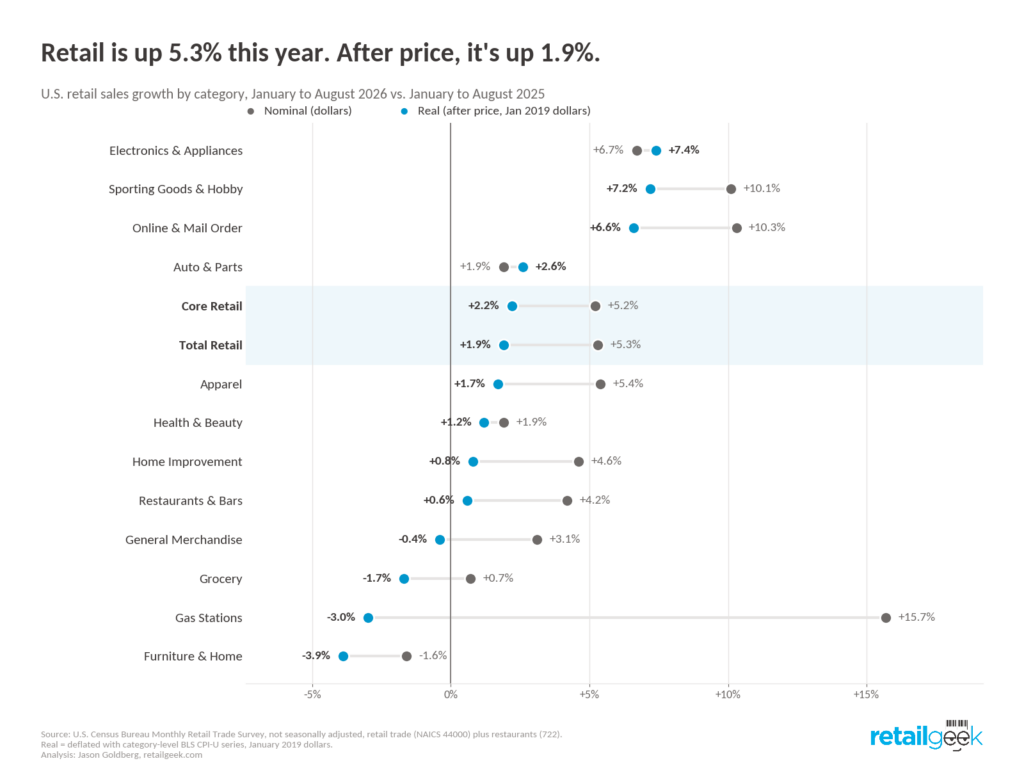
A few other August reads worth pulling out:
- Nonstore retail: +10.4% in dollars, +6.2% real. Still growing at twice the pace of core retail.
- Grocery: dollars fell 0.5% against last August. With food-at-home prices up 2.2% for the year, that’s a 2.7% real decline, the worst month of a year in which grocery hasn’t had a single positive real month.
- Apparel, in the back-to-school month: +3.5% in dollars, -0.1% real. All price. Apparel’s real growth has faded every quarter this year, and August is the first month it went negative.
- Home improvement: +5.2% in dollars, +3.8% real. That’s three straight months of real growth after five straight months of decline.
- Electronics: +7.9% in dollars, +8.5% real, because electronics prices keep falling.
January through August
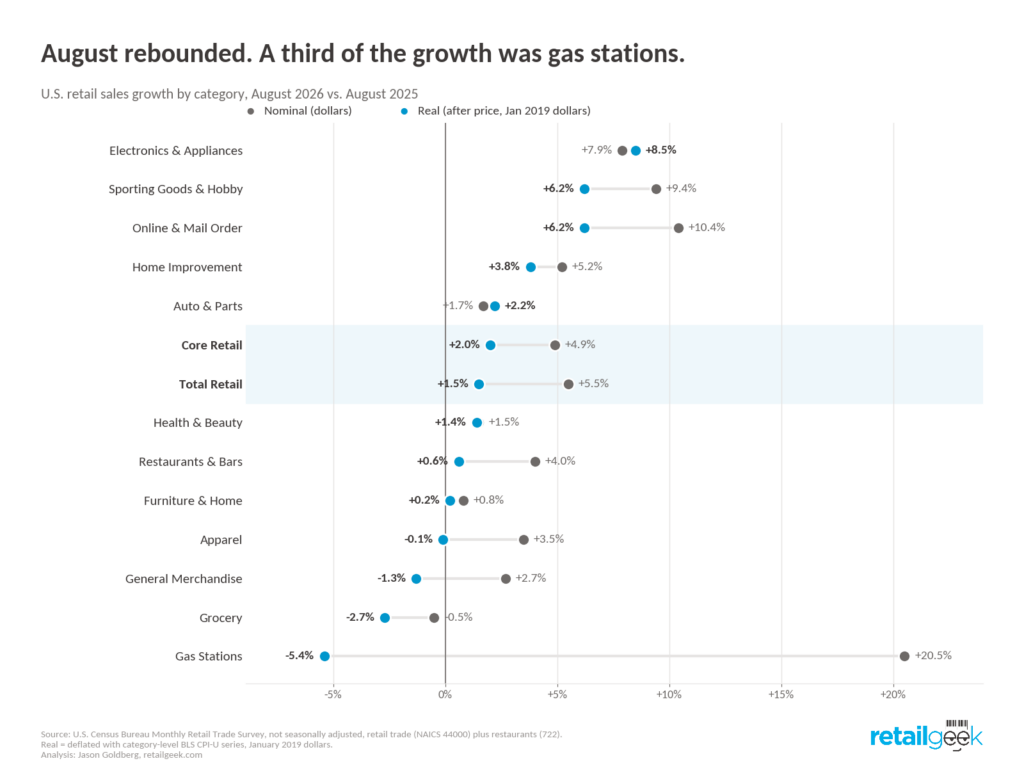
Eight months in, the year-to-date story hasn’t moved much. Core retail is $3.55 trillion, up 5.2% in dollars and 2.2% in real terms. Total retail trade is $5.17 trillion, up 5.3% and 1.9%. About 57% of this year’s core retail growth is price.
The range I gave you last month for inflation was wrong. My assumption was that All Items overstated inflation for home centers and general merchandise because it’s a third shelter. It doesn’t. Tools and hardware inflation is running hotter than the economy, so I’ve started adjusting for inflation on a segment by segment basis. If you do your own deflation adjustments, pick your deflators carefully. I’d rather tell you that than quietly move the number.
The two retail economies are channels now
I’ve been describing “two retail economies” for a while, meaning categories growing in real terms next to categories shrinking. Eight months into 2026, the cleaner split is by channel.
- Nonstore retail: $1.06 trillion year to date, up 10.3% in dollars and 6.6% in real terms. It’s now 30% of core retail, up 1.4 percentage points in a year.
- Nonstore accounts for 56% of all the dollar growth in core retail this year. $99 billion of $175 billion.
- Everything else in core retail, meaning every store-based category combined: up 3.1% in dollars and 0.5% in real terms.
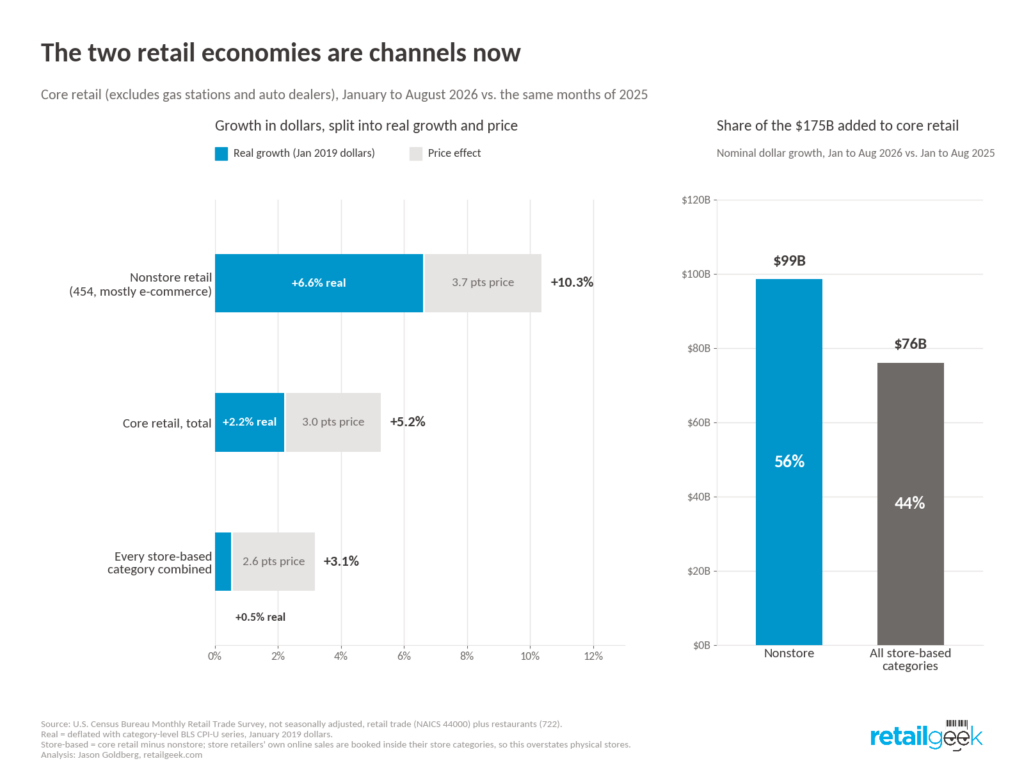
Half a percent. That’s the store-based economy, in aggregate, after price. And that figure is generous, because store-based retailers book their own e-commerce inside their store categories. Big box e-commerce sales land in general merchandise, not nonstore. Strip those out and physical stores are almost certainly negative in real terms this year.
The usual caveat: nonstore is a proxy for e-commerce, not a measurement of it. It includes vending, fuel dealers and direct selling, and misses the digital sales of store-based retailers. The cleaner number is the quarterly e-commerce report, which had second-quarter e-commerce up 12.4% and at 16.4% of total retail, up 0.8 percentage points, according to the Census Bureau. Same story, different instrument.
The category picture
Nominal and real, January through August:
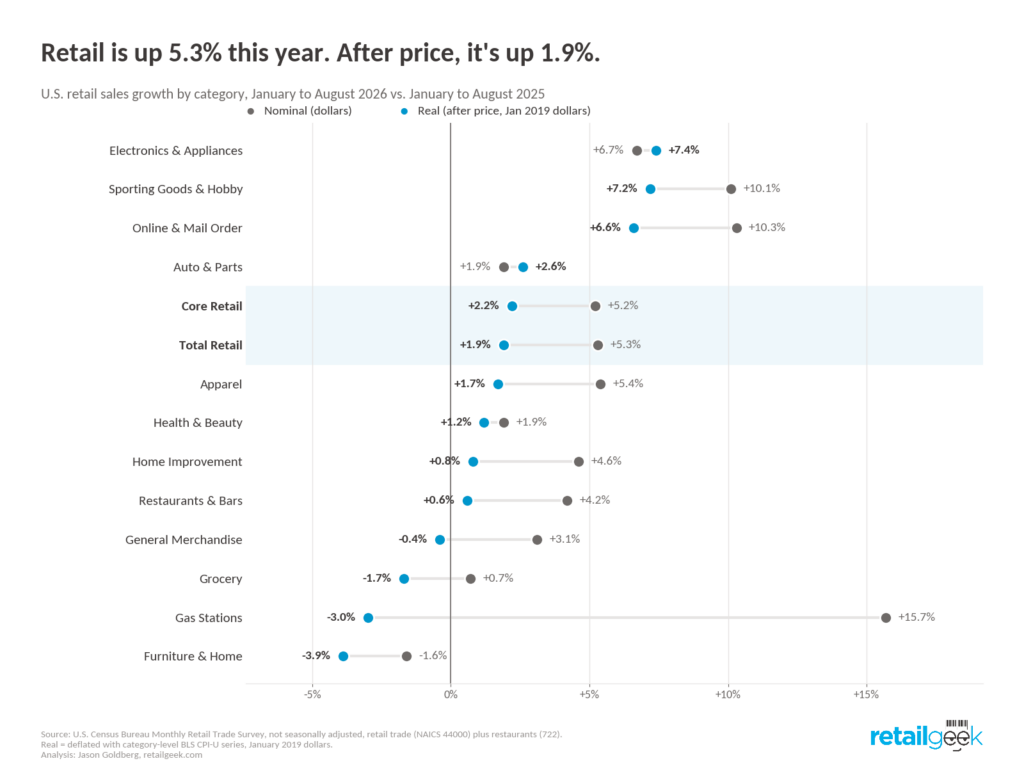
- Gas stations: +15.7% / -3.0%
- Sporting goods and hobby: +10.1% / +7.2%
- Online and mail order: +10.3% / +6.6%
- Electronics and appliances: +6.7% / +7.4%
- Apparel: +5.4% / +1.7%
- Home improvement: +4.6% / +0.8%
- Restaurants and bars: +4.2% / +0.6%
- General merchandise: +3.1% / -0.4%
- Health and beauty: +1.9% / +1.2%
- Auto and parts: +1.9% / +2.6%
- Grocery: +0.7% / -1.7%
- Furniture and home: -1.6% / -3.9%
Four categories are shrinking in real terms. Furniture down 3.9% which is the worst category in retail and still shows no sign of turning. Home improvement, showing some strength. When people can’t move, they fix.
General merchandise at -0.4% real is the one I’d watch most. This is Walmart, Target, Costco and the dollar stores, combined, running slightly negative after price on a generic goods deflator. It’s a coin flip around zero, not a confirmed contraction. But the largest store-based category in America is not growing in real terms, and it hasn’t been in five of the last seven months.
Electronics is the one category where the real number beats the nominal number. Prices fall, so the same dollars buy more. Some of that is more devices and some of it is BLS quality-adjusting a better device at the same price. Don’t call it unit growth. But it’s the healthiest looking category in the data, and it has been every month this year.
What to do Monday morning
Split your growth three ways: price, channel, and everything else. If you’re a store-based retailer running a 3% comp, you’re at the category average, and the category average is roughly zero after price. That’s not a criticism. It’s the baseline you should be measuring against, instead of the 5% topline in the press release.
Check your gas exposure in the consumer wallet, not just your P&L. Americans have spent $65 billion more at gas stations this year than last for fewer gallons. That money came out of something, and the grocery and general merchandise numbers suggest where.
The question I keep coming back to: if nonstore is 56% of the growth and stores are flat after price, is a 5% retail year actually a good year for anyone who isn’t a marketplace?