As co-founder of Stripe & Stare, a British underwear label built on comfort and cleaner fibres, Katie Lopes has spent nearly two decades trying to reinvent one of retail’s most overlooked categories.
Lopes sat down with Retail Gazette to talk about how she has grown the business from a Devon farmhouse start-up into a direct-to-consumer brand navigating supply-chain shocks, tougher new green regulations and rising sector competition.
From kitchen table to cherry pickers
When Katie Lopes, and fellow co-founder Nicola Piercy, launched Stripe & Stare in 2017, the business began in her Devon farmhouse, with stock piled among her children’s Lego. Today, the underwear label operates from a 30,000 sq ft warehouse in Devon, complete with cherry pickers and a team of 20 to 25 staff. It is a far cry from what she describes as the “shoebox office” that followed those early kitchen-table years.
Growth came without the usual start-up playbook. “We didn’t even have a marketing budget and our community did all the selling for us,” Lopes says.
 Word of mouth carried the brand in its first years, before it moved early into podcast sponsorships with The High Low and Fearne Cotton’s Happy Place.
Then came Oprah Winfrey. After first discovering the brand in a US wholesale boutique in Montecito in 2022, Winfrey later featured Stripe & Stare on her Favourite Things list in 2023. “We literally sold out what she posted in a day,” Lopes says.
And now recent figures suggest the company has moved well beyond niche status. Stripe & Stare recorded £5.5m sales in 2023, up from £1.7m in 2020, according to the Financial Times, with the brand reportedly selling more than 2 million pairs of underwear and fifteen thousand five star reviews.
Why Stripe & Stare kept warehousing in-house
Unlike many direct-to-consumer brands, Stripe & Stare chose not to outsource fulfilment. Lopes, who has a background in retail, says third-party logistics (3PLs) providers often struggle during sudden peaks in demand, while the business wanted direct access to stock and flexibility over how products are assembled for sale.
“A black knicker can be sold as a single black knicker. It can be sold as a four-pack. It can be sold with a black bra as a set,” she says, speaking about the brand’s ‘recipes’.
“Not having direct access to our own stock was really frustrating. We need to be able to make things on the fly”.
But that decision for freedom has also brought operational and logistical complexity. Lopes recalls one busy Black Friday after a delayed warehouse move left stock disorganised just as sales came in three times above forecast. The result, she says, resembled the “leaning tower of Pisa” made of boxes.
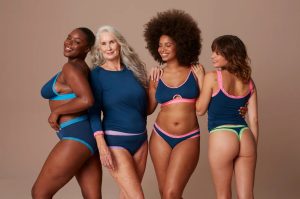 Photo: Stripe & Stare
The wider supply chain also remains difficult. “Since we launched in 2017, I don’t think there has been a moment where there’s felt like calm and consistency in the world on a macro level,” she says, citing Brexit, Covid, inflation, tariffs and Middle East disruption.
The business is currently 49% up year-on-year, Lopes says, but had forecast 60% growth, leaving excess stock to manage.
Likewise, the company aims to ship 80% of stock by sea and 20% by air, but with disruptions in to shipping due to the closure of the Strait of Hormuz and high freight prices due to rising costs of oil, longer lead times often force more expensive, and less sustainable, air freight. “You get used to chaos after a bit,” she added.
Betting on comfort, sustainability… and scrutiny
Stripe & Stare’s pitch rests on comfort and fibre choice. Lopes says she spent years researching fabrics before launch, rejecting cotton for its water and land use, and bamboo because processing it into wearable fibre can be chemically intensive. Instead, the company chose TENCEL modal. “We’re never saying it’s perfect,” she says. “You’ve just got to pick.”
This sentiment carries over to the brand’s choice of suppliers. Lopes began developing the product in 2006, spending more than a decade refining fit, fabric and sourcing before bringing the brand to market. Central to that process was a manufacturing partner in Guangdong, China, whom she met through trips to Hong Kong.
That long partnership helped Stripe & Stare through its earliest years, allowing smaller production runs and product tweaks while the proposition was tested. Yet after Covid, changing customer attitudes towards China, as well as the need to diversify risk, pushed the business to broaden its supplier base. Production now also takes place in India, Vietnam and Portugal, with Portugal used in particular for smaller runs and newer fabric developments.
And Stripe & Stare’s sustainability pitch now stretches beyond fibre choice. The company, which became a B Corp in 2021, after an 18-month process that began in 2020, says its warehouse is plastic-free, with products stored in cardboard boxes or compostable bio-bags. Customer orders are shipped in recyclable paper envelopes or boxes.
 Through a partnership with Ecologi since 2020, the business says it had funded the planting of more than 158,000 trees by April 2026, alongside carbon avoidance projects. The Devon warehouse and office are powered by renewable electricity, according to the company’s Earth Day statement.
For Lopes incoming regulation is less threat than opportunity. On digital product passports and packaging reform such EPR, she says regulation gives smaller, sustainable brands a chance to prove claims in an era of greenwashing.
“It’s yet another layer of work and admin,” she says. “But we also have to welcome it.”
Looking ahead, there is still plenty of room to grow. Lopes says Stripe & Stare’s priority is straightforward: deepen growth in the UK, where brand awareness is still only 8% of its potential customer base. The business also remains firmly focused on direct-to-consumer sales – with around 90% through its own channels and 10% through wholesale partners such as Selfridges and Nordstrom – while overseas markets such as the US, Australia and Ireland will be approached more lightly through press and organic influencer activity rather than heavy paid marketing.
Meanwhile, a new above-the-line campaign is due to launch in June, centred on what Lopes describes as the realities of modern womanhood and the role of dependable everyday essentials. The company’s hero knicker range still generates around 70% of revenue, with bras and sleepwear making up the balance.
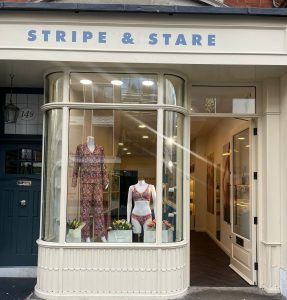
Retail remains a secondary experiment, but not a priority. A recent King’s Road pop-up in London was used less as a long-term store strategy than a place for customers to touch product, for events and for wholesale meetings.
Asked about rivals, she points to legacy giants rather than newer challengers: “Women don’t just have to go to the same place they’ve always gone to buy their knickers.”
For Lopes, the task now is simple but hardly easy: continuing to turn a niche favourite into a mainstream name, and, as she puts it, keep telling more women they are “the best women’s knickers in the world”.
Click here to sign up to Retail Gazette‘s free daily email newsletter