In France, Cisco is working with a major European bank to design a next-generation artificial intelligence (AI) data center. This new system is being built to reduce energy costs and shrink the bank’s AI compute footprint. It combines high-density compute, immersive cooling, and advanced network automation to manage the growing demands of AI workloads.
As this system comes together, we’re offered an early view of how AI infrastructure will need to operate at scale. Systems will need to balance performance with realities of power, cooling, and space. At the intersection of networking, compute, security, and sustainability, Cisco is addressing this challenge.
The way progress is measured is shifting. Performance still matters. But the system’s ability to sustain it will determine AI’s speed and growth. And the gap between what AI requires and what infrastructure can reliably deliver is emerging as one of the defining challenges of our time.
Trust in AI will increasingly be shaped at the infrastructure layer: in how energy is managed, how systems are secured, and how organizations account for their impact. That is the lens through which Cisco approaches sustainability in the AI era. Not as a parallel priority, but as an important determinant of performance, cost, resilience, and trust.
The energy constraint is real
AI is advancing at extraordinary speed. But the systems that power it are evolving at a different pace.
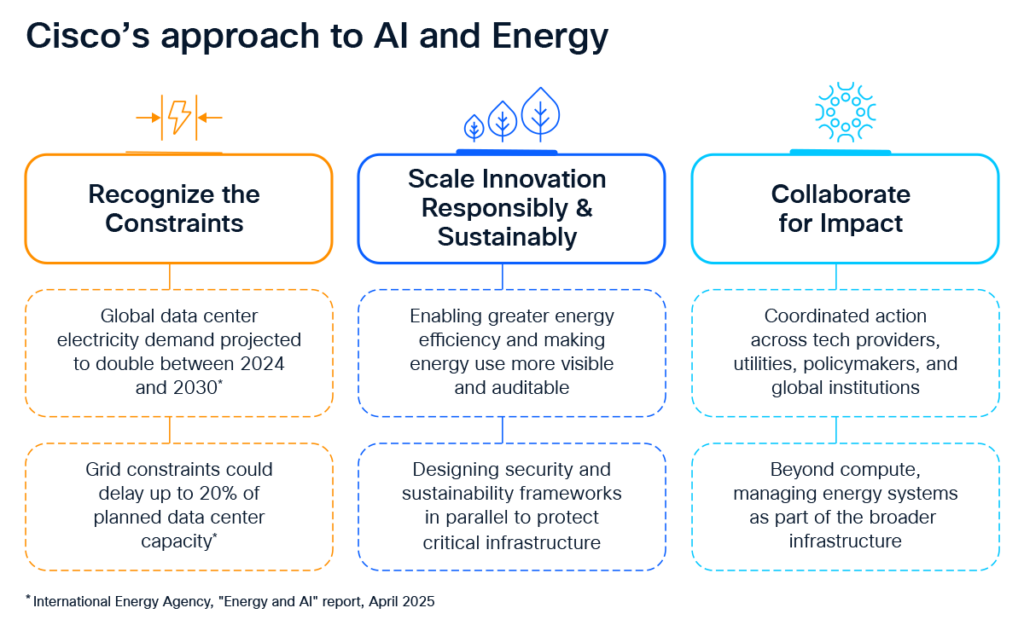
Global data center electricity demand is projected to more than double by 2030, compared to 2024, according to the International Energy Agency. At the same time, the IEA estimates that grid constraints could delay up to 20% of planned capacity. AI is scaling within real limits around power, cooling, materials, and infrastructure resilience. Those limits are beginning to reshape how technology is governed, financed, and deployed.
Inquiries from our customers around topics like energy efficiency, energy consumption, and materials use continue to increase in volume and complexity. This points to a broader change in operating requirements.
We cannot simply outbuild the energy challenge. We have to out-engineer it.
We are applying that same discipline to our own operations, working toward Cisco’s public goal to reach net zero greenhouse gas emissions across our value chain by 2040.
The role Cisco plays
Cisco sits at the intersection of networking, compute, and security. At this infrastructure layer, digital systems and energy systems converge, requiring constraints to be managed in real time.
Our role is to help customers and communities scale innovation responsibly and sustainably, within real-world constraints. That includes enabling greater energy efficiency, making energy use more visible and auditable, extending the life cycle value of infrastructure, and securing increasingly distributed environments.
Security and resilience are closely tied to sustainability. As AI systems become more distributed and energy systems more digitized, the attack surface expands. For critical infrastructure operators and regulators, security and sustainability frameworks should be designed in parallel, not sequentially. Protecting the grid, the data centers that support AI, and the networks that connect them requires secure, observable, and resilient infrastructure by design.
For Cisco, this means enabling more, responsibly, and at scale.
Why collaboration matters now more than ever
No single organization can address these challenges alone.
The convergence of AI and energy is reshaping regulatory, economic, and infrastructure systems simultaneously. This is an opportunity to coordinate across technology providers, utilities, policymakers, and global institutions.
As one step to deepen that collaboration, Cisco has joined the Coalition for Sustainable AI, contributing to global dialogue on responsible, energy-efficient, and trustworthy AI development.
This reflects a shared recognition: the future of AI will be influenced not just by compute advances, but by how effectively energy systems are managed as part of the broader infrastructure.
 What sustainability means in the AI era
Sustainability shapes how systems are designed, operated, and governed.
While many organizations focus on AI as a compute challenge, it is equally a power, cooling, materials, and infrastructure resilience challenge. As digital and energy systems converge, energy is increasingly managed as part of the digital infrastructure itself. The network becomes a control layer, providing visibility, coordination, and security across environments, from campus to data center to grid. Increasingly, AI itself is part of the solution, helping optimize cooling loads, predict grid stress, and allocate energy more intelligently across distributed systems.
Visibility enables informed decision-making.
Through Cisco Energy Management and our observability platforms, organizations can measure, manage, and report energy use with greater precision. This supports more informed decision-making, stronger compliance, and transparent reporting.
Efficiency becomes a system requirement.
At Cisco, many of our products exhibit high performance per watt, as demonstrated by our Silicon One architecture and UCS platforms. Our smart building solutions use Power over Ethernet to reduce wasted energy while improving operational control. At our Penn 1 office retrofit in New York City, these approaches contributed to a 36% reduction in energy use while maintaining performance and occupant comfort. In fiscal 2025, Cisco sourced renewable electricity to match 100% of our annual electricity needs for all Cisco owned and leased property globally (approximately 1.4 million megawatt-hours), with progress tracked publicly in our annual Purpose Report.
Resilience depends on a modernized grid.
Our Industrial IoT portfolio helps utilities digitize, secure, and optimize operations, integrating distributed energy sources while supporting reliability. This is where digital and physical infrastructure intersect, and where secure connectivity is increasingly essential.
Sustainability also requires infrastructure built to last. We design products for durability, repairability, and reuse. Today, 100% of new Cisco products and packaging incorporate Circular Design Principles. Programs like Cisco Refresh extend product life cycles, reduce waste, and provide cost-effective alternatives for customers managing tighter capital constraints.
Enabling AI at scale, responsibly
Our customers balance competing demands for performance, security, and sustainability. Many of our largest customers have established their own sustainability and emissions reduction goals. They depend on trusted data, efficient infrastructure, and secure systems to meet them, and increasingly, so do the regulators and investors evaluating them.
At Cisco, we focus on enabling AI within real-world constraints:
- Efficient infrastructure that operates within power and cooling limits
- Energy visibility and operational control to support compliance and reporting
- Secure, distributed architectures that help protect critical systems
- Grid-aware solutions that support resilience and stability
- Circular design that helps preserve life cycle value and reduce waste
- Reliable sustainability data management that supports customer requirements
The Path forward
The innovators in that Paris data center are not only trying to solve for today. They are helping define what scalable AI looks like in practice. The infrastructure decisions made in the next several years are likely to shape how AI scales for decades.
AI will be one of the most consequential technologies of our era. But its success, and its trustworthiness, will depend in part on whether it can scale sustainably and responsibly. Efficiency helps set the pace. Security and resilience help determine whether that growth can be trusted. And sustainability helps connect them.
Getting this right will require more than engineering. It should include partnership across industry, government, and the institutions that support both.
At Cisco, we believe the future of AI will be built on infrastructure that is efficient, secure, resilient, and accountable by design.
Learn more about our approach to energy and sustainability in the Cisco Purpose Reporting Hub.