Learn how ThousandEyes transformed its deployment culture from manual, fragmented release cycles to a centralized delivery model—using GitOps alongside standardized automation, policy-driven controls, and shared operational practices. The result is a unified, auditable path to production that strengthens digital resilience and developer productivity by reducing manual handoffs, accelerating delivery, and enabling faster detection and remediation. Now being adopted by other Cisco business units, the model establishes the foundation for agentic promotions.
In the world of software engineering, “release day” is often a source of friction. It implies manual checklists, coordination meetings, and a heavy reliance on institutional knowledge. At Cisco ThousandEyes, we realized that this bottleneck was incompatible with our goal of delivering rapid, reliable innovation. We needed to stop treating releases as distinct events and start treating them as a continuous, automated, and governed business process.
The Challenge: Fragmented Visibility
Our previous release model treated environment promotions as largely manual processes. Release state was scattered across GitHub deployments, approval threads, and institutional knowledge, making it difficult to establish a single source of truth. While controls such as freeze windows and deployment reviews existed, they were applied inconsistently across teams and workflows.
For ThousandEyes, the delivery challenge was not just speed; it was digital resilience: we lacked a unified, auditable path from staging to production, and assessment controls were fragmented across multiple systems. This limited our ability to continuously evaluate risk, enforce governance consistently, and rapidly identify and remediate issues throughout the software delivery lifecycle. Continuous promotion directly addresses that gap by making promotion state, policy, and readiness criteria explicit, centralized, and continuously enforceable, rather than dependent on release-day coordination.
The Solution: a centralized CD control plane with an enforceable verification layer
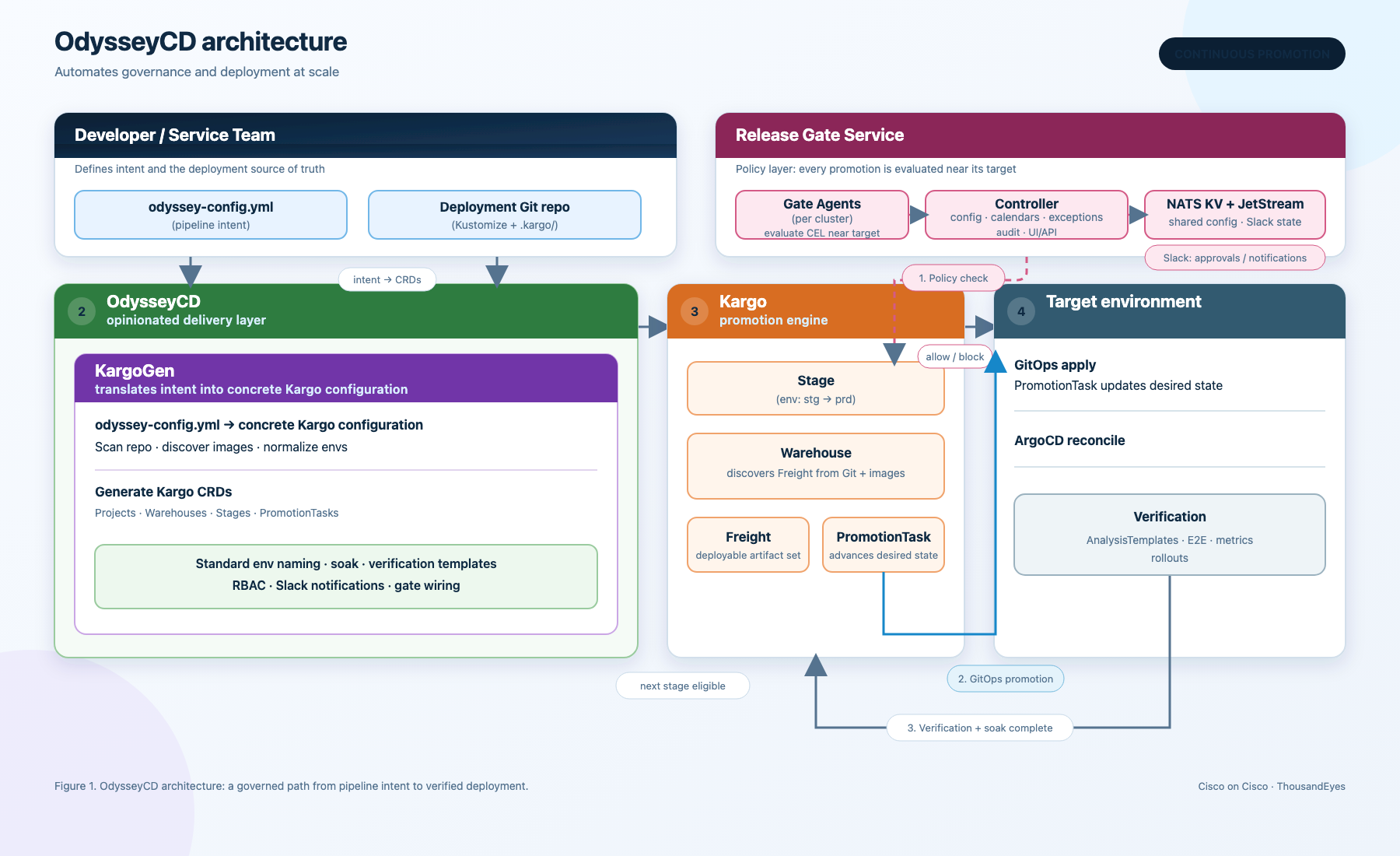
To modernize software delivery at scale, Cisco ThousandEyes built OdysseyCD, our internal continuous delivery (CD) platform, on Kargo. OdysseyCD provides a continuous promotion framework that simplifies the developer experience while strengthening delivery governance. Reusable verification gates and standardized promotion patterns let teams and Cisco business units apply consistent release-readiness checks and controls without rebuilding promotion workflows for each application, environment, or organization.
We focused on three core pillars:
- KargoGen: Standardizes configuration generation, allowing teams to define intent in a simple file while the system handles the underlying complexity. This prevents configuration drift while removing manual configuration steps.
- Release gate service: Centralizes release-policy and approval decisions, including calendars, end-to-end validation, audit records, and exceptions. Slack provides the user interface, while a durable system of record preserves consistent, auditable decisions across tools and environments.
- Continuous promotion: Integrating Kargo with ThousandEyes automation replaces manually coordinated deployments with a policy-driven release-promotion workflow. A release-promotion progresses through the stage graph only after automated validation, reducing manual release coordination and enabling more reliable, continuous progression from staging to production.
Measuring Impact
OdysseyCD is now operating at fleet scale, demonstrating that automated promotion and centralized governance can coexist across a high volume of release activity. Today, we manage:
- 137,000+ release gate evaluations performed every 30 days.
- 9,000+ Kargo promotions each month.
- 98,000+ gate events surfaced monthly through Slack, providing real-time visibility into release readiness and promotion policy compliance.
- 1.4 million warehouse reconciliations executed each month.
- 96 release gate agents actively enforcing governance controls, with adoption continuing to expand.
This shift has changed the day-to-day work of our engineers. Developers no longer manage release tags or coordinate freeze windows manually. Instead, they work through a clear, visible promotion model that shows what is deployed, where it is running, how it arrived there, and whether it is ready to advance. Automated validation and policy-driven progression replace recurring release coordination, allowing engineers to focus on delivering software rather than managing releases.
A Foundation for the Future
For our engineering and operations teams, the focus has shifted from executing releases to defining policy, monitoring outcomes, and continuously improving delivery. By making promotion state explicit and auditable, OdysseyCD has standardized governance across teams while reducing manual handoffs, accelerating feature delivery and time-to-market, and shortening the time to detect and remediate issues, core outcomes of Cisco’s digital resilience strategy.
This is more than a technical upgrade; it is a reusable foundation for resilient software delivery across Cisco. OdysseyCD provides common promotion patterns, reusable verification gates, and centralized policy mechanisms that other business units can adopt while applying the policies and readiness criteria appropriate to their own services. This shared model supports more consistent governance and an auditable path to production across participating organizations.
Our next evolution is what we call agentic promotions. Building on the continuous promotion model operating today, AI agents will continuously assess quality, reliability, security, and compliance signals against defined policies to determine promotion readiness. This evolution will further improve delivery velocity, governance, and digital resilience through continuous assessment and automated remediation while preserving a fully auditable, policy-driven path to production.
Stay tuned for part 2, where we’ll explore how agentic promotion builds on this foundation to further transform software delivery through AI-driven decision making, automation, and continuous governance.
Interested in learning more about how Cisco teams are transforming their internal operations? Explore more Cisco on Cisco stories here.