When athleisure came along, it didn’t just redefine what activewear retailers sold. It constituted a new era of apparel, where everything from dress shirts to denim got a stretchy makeover.
At the forefront of that movement, of course, was Lululemon. A brand that started with yoga pants grew to sell more workwear or commuter-style products like the ABC pant and got used to seeing double-digit sales growth as shoppers happily filled their closets with high-priced active-inspired apparel.
Vuori, Alo Yoga and more have taken their cues from the athleisure powerhouse when it comes to pricing, positioning their products as more of a premium purchase. They’ve also taken category expansion head-on, seeking to push the boundaries of just how much of a shopper’s wallet they can grab — and that’s not necessarily a bad thing.
“Adding a category can be a great strategic move, but the category has to make sense. It has to make sense for your customer or your brand DNA,” Liza Amlani, principal at Retail Strategy Group, said, adding that for wholesale brands, they must also think about product fit with retail partners. “There has to be alignment. It can’t just come out of thin air.”
But recently, shoppers have been telling activewear retailers in a couple of different ways that they’re missing the mark. The interest in athleisure is still there, but what do brands need to do now to win?
Are consumers moving on from athleisure?
Perhaps a clear sign of the times is the stark financial reality Lululemon has faced recently.
Usually a very solid performer, Lululemon admitted in September that it had been missing trends and needed to rethink its design processes. The issues stem in part from not investing in its innovation hub, according to Amlani, and indeed, Lululemon is banking on newness as a cure to its ailments.
Asked about challenges in the sector and at Lululemon specifically, a spokesperson cited efforts discussed on its most recent earnings call to increase the frequency of new styles, rebalance its merchandise mix and bring “new energy” to its product assortment.
“In a highly competitive environment, we differentiate our brand through our Science of Feel product development platform and innovative performance offerings, and we remain confident there continues to be market share to capture,” the spokesperson said. “We know when we get our product right, guests respond, and we look forward to continuing to drive improvements across our product portfolio and business over the coming quarters.”
While some of the stumbles are Lululemon’s to own, it’s also harder to grow in the category right now.
“When you see lots of growth in a market, it’s hard to keep sustaining that growth,” Suzy Davidkhanian, who leads the retail desk at Emarketer, said. “Until there are either new brands or completely new categories in athleisure, I think it’s going to be hard to see lots and lots of growth.”
Davidkhanian added that any category in apparel will struggle “if everything looks the same as last year,” and budget-conscious consumers may need the extra push of new colors and silhouettes to justify purchases right now.
It’s not activewear that’s lost its premium appeal, according to observers, it’s uninteresting activewear that has. And with more competitors than ever, the bar is higher.
“One of the issues facing [Lululemon] is the rise of new athleisure brands, some of whom are operating at similar price points and opening stores in similar real estate,” Needham analysts led by Tom Nikic said in emailed comments in September. “With brands such as Alo, Vuori, Fabletics, Athleta, and others all providing ‘athleisure’ options for consumers, we believe it is stifling [Lululemon’s] growth.”
Needham analysts also mentioned rising competition from traditional apparel brands, including lines like Free People Movement and Offline by Aerie.
Shoppers are getting more discerning the longer athleisure is around. Fans on Reddit have bemoaned higher prices and lower quality at Lululemon and Vuori over the years. Alo Yoga, too, gets its fair share of complaints around high prices versus quality. And Outdoor Voices, which relaunched to much fanfare earlier this year, has faced similar complaints around its new products compared to the brand’s older lines.
In response, a Lululemon spokesperson said that product quality and innovation is “at the heart of everything we do, and our priority is to ensure that every single piece of gear that we create performs at the highest level for our guests.” The spokesperson added that Lululemon’s pricing strategy “reflects this ongoing commitment” and that the brand listens closely to shopper feedback.
None of the other brands responded to a request for comment about these complaints.
It’s important to address quality concerns upfront, otherwise shoppers will begin questioning why they’re paying so much for these products, according to Davidkhanian, who referenced Lululemon’s challenges with see-through leggings in the past. But broader apparel trends are also shifting, which threatens not just Lululemon, but the whole swath of its athleisure competitors.
“Younger consumers have clearly gravitated to wide-leg jeans in recent years, potentially at the expense of [Lululemon]’s core product (women’s tight-fitting leggings),” Nikic wrote in September.
Indeed, a recent report by Competitoor found denim was in high demand, with prices of denim jackets, for example, rising 34% in the 12 months ended Sept. 5. Davidkhanian noted that during athleisure’s rise, many people were buying leggings to replace their jeans. Now, there’s more innovation going on in the jeans world than in the leggings world — and so trends are shifting again.
“Skinny jeans were big, everybody bought them — and then nobody needed more blue ones, so then they came in every color under the sun,” Davidkhanian said. That worked for a while and then it became tired and shoppers shifted their spending elsewhere when the innovation stopped. “Now they’re seeing new fun denim and not so much new fun leggings. And so they’re moving on.”
‘It looks like chaos’
As shoppers move beyond leggings, athleisure brands are increasingly following.
Athleisure has toed the line between performancewear and lifestyle garb for years — especially as it’s become more acceptable to sport casual styles for more serious events — but those efforts are going even further these days. Vuori, for example, is now selling denim for $188 and Outdoor Voices is doing the same for $168, alongside cardigans that retail for just shy of $150.
Furthering the category’s luxury ties, Alo Yoga even launched its first luxury bag collection this year, featuring a travel duffle priced at $3,600 and a drawstring bucket bag priced at $2,000, among other items.
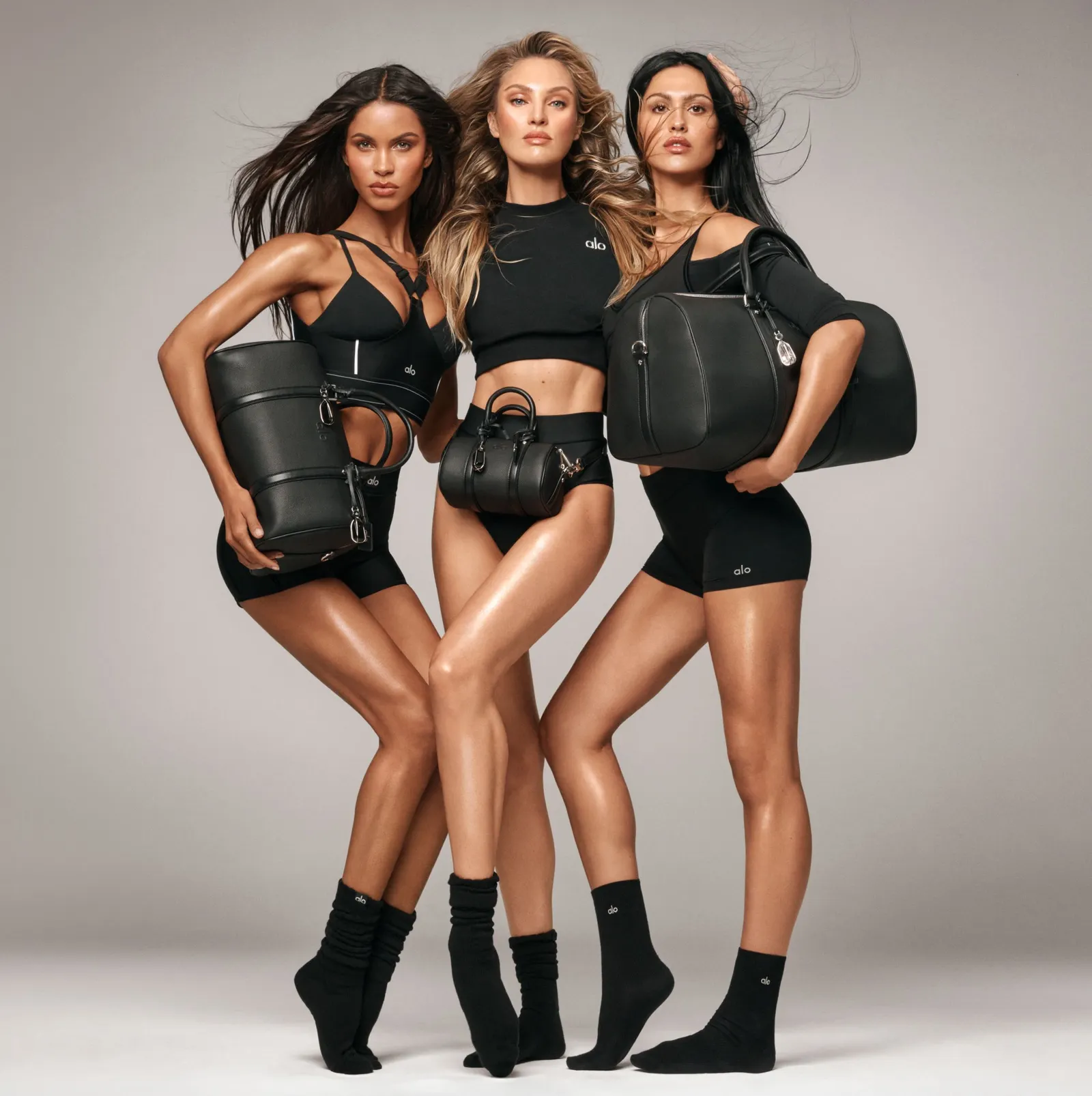
Alo Yoga’s luxury bag collection includes leather duffles.
Courtesy of Alo Yoga
“Are we going to Vuori for denim?” Amlani asked of that effort, adding that the denim looks relatively basic.
Vuori didn’t respond to questions from Retail Dive about what the reasoning behind the recent denim launch was, though 30 reviews on the retailer’s site so far have given the product 3.5 stars. Among those reviews were a few complaints over the fabric being too heavy and the fit being too baggy.
Outdoor Voices pitches its own jeans as a “cowgirl” style designed for equestrians, part of a broader collection that also includes $188 riding pants and $108 polos. The brand’s community on Reddit features customers questioning the move or confused about the brand’s new approach. Outdoor Voices did not immediately respond to a request for comment on the reasoning behind the launch or the online commentary around the products.
“You can totally extend your category — that’s totally fine,” Jessica Ramírez, co-founder and managing director of The Consumer Collective, said. “You have to do it carefully if it’s not in your wheelhouse and you have to test, and as you’re testing, understand what is resonating with the consumer.”
Ramírez added that developing apparel-based silhouettes using performance fabrics introduces additional challenges because those fabrics don’t always sit on the body the same way. That can be particularly hard for items like dresses, and bottoms can be “hit or miss,” she said.
Sharon Zackfia, a research analyst at William Blair, also warned that markdowns are likely to be higher the more fashion-oriented apparel a brand offers.
“I think the question on how broad a brand goes … first, it’s what permission does the consumer give you to go there? Do you have any credibility in that space? Do you bring anything new to that space?” Zackfia said. “Is there a reason why the consumer would want you to be there?”
That’s the harder part. Alo’s bag launch, for example, garnered criticism from some on Reddit for its high prices and luxury appeal. Alo Yoga did not immediately respond to a request for comment about the reasoning behind the launch and the customer response to the collection.
Outdoor Voices’ whole relaunch — cowgirl jeans notwithstanding — has found some consumers questioning the cost of items and generally lamenting the loss of what the brand once was.
According to Amlani, some of Outdoor Voices’ problems come down to an assortment that doesn’t mesh well together, including colors and styles that don’t pair well.
“When you think of how a merchant will source a collection — they look at outfits, colors, categories that can either sit together or that can layer on top of each other. This assortment makes no sense to me,” Amlani said of Outdoor Voices’ recent collection. “It looks like chaos.”
In some cases, customers agree. Complaints abound on the brand’s Reddit page around items like the Boulder Dress and the styling decisions on Outdoor Voices’ website. Others are more complimentary of the direction of the business, with many on Instagram praising the equestrian launch and items like the Diamanté Doing Things Hoodie.
To Amlani, some of the misfires mean the brand doesn’t have the right feedback loop in place.
Fixing that and focusing on retail fundamentals may be the answer for any athleisure brands that find themselves too far astray.
“I doubt that the bottom is going to fall out from under any athletic or athleisure brand,” Amlani said. “The problem is, can each of these brands demonstrate the appropriate product development, merchandising and process discipline to deliver a compelling assortment?”