Adam Newington and Callum McIntyre-Nash are applying their subscription expertise to a low-frequency greetings-card service that champions living artists, thoughtful communication and convenience without compromise.
The inspiration behind The Card Boys, a quarterly subscription which delivers eight premium, artist-designed cards, did not spring from reinventing the greetings card. It began with a more familiar problem, simply remembering to buy a good one before it was too late.
Newington and McIntyre-Nash spent six years at Freddie’s Flowers, joining when the flower-subscription business was still small, and helping it grow to more than 100,000 users. That experience gave them a practical education in subscription retail, and in the emotional pull of products that help people show they care.
“We weren’t really trying to reinvent a greeting card. We were more trying to change how people buy them,” says Newington.
“We learnt our craft in terms of subscription-model businesses, the benefits a customer can get from that, and psychologically why it can be really useful and solve problems.”
A card “drawer” of their own
The founders also knew the customer problem first-hand. Newington jokes that they were “two useless men”, dependent on the card drawers maintained by girlfriends and mothers, or left buying something uninspiring at the last minute. The alternative, an online service that types and sends the message for the customer, could feel convenient but impersonal.

McIntyre-Nash adds that tension has become more pronounced as everyday communication has moved on to screens.
He explains: “Most communication is done by text or email or WhatsApp, and those thoughtful messages are getting lost a little bit.
“You will keep a card or a letter that somebody sent you way longer than you would remember a text, a WhatsApp or a little meme someone sends you on your birthday.”
The Card Boys is designed to make that lasting gesture easier. Customers receive curated collections of cards to keep at home, ready for the moment they are needed. This model is intended to remove the frantic dash to the shops without stripping away the handwriting, choice and thought behind the message.
“I love sitting down and writing a card and giving it to someone,” Newington notes. “Spending the time to do it is not the issue. My issue is: am I going to get to a shop and pick up a nice one in time? Am I going to remember to do that with a busy life?”
Turning every card into artist-discovery
Convenience is only one half of the proposition. Both founders have backgrounds in the arts, while many of their friends and relatives are artists. The overlap gave them an opportunity to build a card service that could also introduce customers — and recipients — to contemporary creative talent.
Newington argues that buying art can be daunting, even for consumers who have reached the point where they want to invest in pieces for their homes. The same discoverability problem applies to greetings cards. Museum and gallery shops offer plentiful art cards, he notes, but they tend to celebrate artists from the past.
“Why are we not celebrating living artists, people that are coming up through the ranks?” he asks.

“A big part of it is discoverability. There’s so much out there — how do you sort through it? There’s an element of trying to make that more accessible to everyone and a bit less daunting.”
Each Card Boys design carries information about its creator on the reverse, including a photograph, biography and links to their work. That makes the physical card a point of discovery twice over: first for the subscriber, and then for the person who receives it.
McIntyre-Nash says some of the business’s most satisfying results have come when customers go beyond the card itself.
He shares: “People have reached out to the artists directly, either going on their sites and buying their work, or commissioning them to make new stuff.
“The customer sees the artist and their designs, then sends the card to a friend who discovers the artist as well. That journey is a really satisfying one for us.”
The subscription structure also gives the founders greater certainty over print volumes. In turn, they can offer artists a fixed fee rather than relying solely on commission. Newington says the sums are still modest while the company is small, but the principle matters: as the customer base grows, so should the fee paid to the creative contributor.
A subscription designed not to overwhelm
The founders believe the product’s non-perishable nature gives The Card Boys an advantage over many subscription businesses. Cards do not expire or force customers into a rigid consumption cycle. The service makes four deliveries a year, with an optional fifth Christmas box, and subscribers can skip deliveries or dip in and out.
“The biggest reason people leave subscriptions is that it’s too much, too often,” says Newington. “We very deliberately wanted this to be low-frequency and easy to manage. You can keep it in a drawer and use it when you’re ready.”
McIntyre-Nash adds that the model draws on the pair’s combined experience across subscription brands, much of it involving perishable goods and the logistical pressure those products bring.
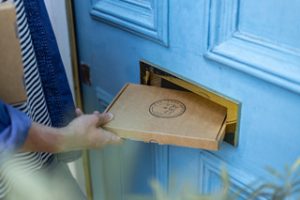
He says: “Understanding the difficulties around logistics and delivery gave us even more incentive to have a product like this. It’s non-perishable, it’s easy to store for us and for a customer, and, if it’s kept well, they can use it years later if they need to.”
The early retention data is strong, according to the founders, but they are not treating that as a reason to stop listening.
Many customers first met them face to face through the guerrilla-style selling that launched the venture, and the pair still call subscribers, test designs ahead of time and seek feedback on the balance of each collection.
That slower product cadence is useful. Rather than churning out new designs every week, The Card Boys can spend time curating a varied box, showing the work to customers and refining the offer between quarterly deliveries.
Newington shares: “We want to make sure people are seeing the designs beforehand. If they don’t like them, they’re not having to have them. We’ve got a lot better at curating the boxes, but there’s still ongoing work to do and we need to make sure there’s a nice, diverse range within each collection.”
Proving the model — and preparing to scale
The Card Boys has so far been built around full-time jobs, evening messages and weekend work. The founders each started with £500, taking an easel, a blackboard and a selection of cards to Peckham Rye to ask passers-by what they made of the idea. That direct approach echoed the grassroots customer acquisition they had used at Freddie’s Flowers — and suited a venture whose purpose is human connection.

Since then, more than 1,000 people have used the service and the founders say they have built a current customer base of around 500. Each has invested roughly £5,000, keeping the emphasis on capital efficiency while testing paid social alongside face-to-face acquisition.
“A lot of consumer subscription models in ecommerce spend an awful lot of money to get to the proof points we’re at now,” notes Newington. “Everything has become about capital efficiency: how can we get the most for nothing?”
The pair are now seeking £150,000. The immediate goal is to step into the business full-time and demonstrate that its acquisition economics continue to hold as marketing spend increases. If it can maintain customer-acquisition cost, payback and retention at greater scale, the founders believe they will have a stronger platform for a subsequent raise or other routes to growth.
McIntyre-Nash says the competitive position rests on combining the ease consumers expect from established online card businesses with a more tactile, curated and artist-led experience. “We want convenience to be very high up on the list of what we’re doing, but also quality — and really emphasising that human connection.”
These two former Freddie’s Flowers employees have identified an opportunity to bring the lessons of subscription retail to the greetings-card market, while building a business that supports living artists and makes considerate habits easier to keep.
The commercial challenge will be proving that a purposefully infrequent subscription can scale efficiently. But the emotional case is already clear. In a market where speed often wins by removing the personal touches, The Card Boys is betting that shoppers still want convenience — just not at the expense of the handwritten message.
Click here to sign up to Retail Gazette‘s free daily email newsletter