TikTok Shop UK boss Jan Wilk says live selling, founder-led content and discovery are reshaping how brands reach shoppers. With 300,000 UK small businesses now on the platform and LIVE sales up 55 per cent in a year, what can retailers learn from the businesses getting it right?
Scroll through TikTok, and its clear that the line between entertainment and shopping has become increasingly hard to spot.
A beauty founder might be explaining why she changed the formula of her latest serum. A MAC employee could be broadcasting from inside a store, or a sneaker seller might be auctioning off a hard-to-find pair live to hundreds of viewers.
For TikTok Shop UK head Jan Wilk, that’s precisely the platform the company has been trying to craft.
The biggest change in recent years, he says, has been the number of businesses treating TikTok as somewhere to build a retail operation, rather than simply advertise one.
“We’ve seen huge growth in small and medium businesses building their entire retail strategy around TikTok Shop, using it not just as a sales channel but as a way to test products, build a community and grow a brand from scratch,” Wilk says.
There are now more than 300,000 UK small businesses listed on TikTok Shop. At the other end of the market, established retailers including Debenhams and QVC have also joined.
Wilk says those bigger names have, in part, been following the lead of smaller businesses that proved the model could work.
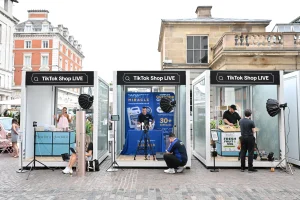
LIVE Shopping has been one of the clearest areas of growth. TikTok now hosts more than 6,000 LIVE Shopping sessions a day in the UK, while sales generated through LIVE have increased 55 per cent over the past year.
And whilst it’s a format that works seemingly extremely well for visibility, Wilk sees live selling as more than a conversion tool.
“The growth of LIVE shopping tells us that real, human interaction is a vital part of the shopping experience,” he says.
“Whether it’s through demonstrations of the product itself, or answering questions coming direct from viewers in real-time, the more you engage with your audience to give them trusted insight, the more they will come back to you.”
Discovery before search
TikTok describes its model as “discovery commerce”. The idea is simple. Rather than opening a retailer’s website with a product already in mind, a shopper encounters something through a creator, trend or video and can buy it without leaving the platform.
Wilk says that compression of discovery, consideration and purchase is what separates TikTok Shop from more conventional ecommerce.
“When trends are born on TikTok, shoppers can go from discovering a product or trend they’re interested in through their favourite creators, to learning more about it, and buying that product, all in one journey.”
That also changes how brands compete for visibility.
Traditional ecommerce often rewards scale. Retailers with the largest marketing budgets, strongest search positions or biggest customer databases tend to have an advantage.
Yet TikTok Shop’s pitch is that its For You Feed can put a small seller in front of an interested shopper without requiring either a huge audience or a large advertising budget.
“Shoppers aren’t shown an undifferentiated catalogue,” Wilk says. “Instead, they’re shown what’s relevant to their interests and previous activity on the app.”
“That means sellers don’t need huge followings or big budgets for their products to be discovered. A small independent seller has the same shot at reaching the right customer as a major retailer, because visibility is driven by relevance to the community.”
That strategy creates a lot of opportunity, but also surfaces a different set of rules.
Products need to work in content. Founders, employees and creators can become part of the sales operation and the brands getting traction are often those willing to show how products work, rather than simply present polished campaign imagery.
From shop floor to livestream
Wilk raises MAC Cosmetics as one example of a large brand adapting its model.
The brand announced plans this year to introduce in-store LIVE studios for employees, giving store staff the opportunity to sell and demonstrate products to online audiences from within its physical estate.
“This is the perfect example of how TikTok Shop works in tandem to reach audiences beyond their in-person stores,” Wilk says.
It’s a notable shift in the role of shop-floor staff.
The employee who might previously have advised a handful of customers during a shift can now demonstrate a product to an audience far beyond the walls of the store. For smaller businesses, the founder can perform much the same role.
Wilk also notes beauty brand Glow For It, launched by Daisy Kelly in 2020, as one of the strongest examples.
Kelly documented the process of building the company, including product development, behind-the-scenes updates and customer transformations.
That founder-led approach helped the company build an audience before turning social engagement into sales.
Glow For It now generates around £6m in annual sales, according to TikTok Shop, with more than 40 per cent coming through the platform.
The lesson Wilk takes from businesses like Glow For It is that brands don’t need to look overly polished. “My advice would be to lean into it,” he says.
“We speak to so many sellers across sectors that talk about how apprehensive they were about LIVE selling before trying it themselves.”
Some, he says, begin by working with creators who host LIVEs on their behalf. Others start with the founder talking directly to camera.
“Many communities on TikTok Shop respond well to authenticity, which is more valuable than having a polished strategy.” From there, Wilk argues, repetition is vital.
“Consistency is key, keep engaging with your audience, and they will continue to engage with your brand.”
Auctions, sneakers and collectables
TikTok Shop is also experimenting with formats that make ecommerce behave more like entertainment.
For example, LIVE auctions are growing particularly quickly in categories where scarcity and fandom already shape buying behaviour.
Sneakers are a perfect case study. TikTok says the number of sellers in the category has increased nine-fold.
Collectables are another. LIVE auctions now account for around 40 per cent of sales in the category, with sellers using broadcasts to offer trading cards, limited items and releases that shoppers may have missed first time around.
“We’re seeing more interactive LIVE shopping formats take off on TikTok Shop, including LIVE auctions, which give sellers another way to engage their audiences in real time,” Wilk says.
“This is resonating particularly with enthusiast communities like sneakers and collectables, where people are often looking for specific, limited, or hard-to-find items.”
The appeal is easy to understand. An auction creates urgency, but viewers can also ask questions, see the product and interact with the seller before buying.
Wilk says the emphasis is on “community, discovery and trust” and giving buyers enough information to make a confident decision.
Retail gets personal again
For all the technology involved, TikTok Shop’s argument to retailers is ultimately centred on people.
Static product pages can tell a customer what an item costs, what size it comes in and whether it is in stock. They are less good at answering the small questions shoppers often ask before committing to a purchase, such as, what does it actually look like on? How does it work? Is the quality good? What would you pair it with?
“Businesses recognise static product imagery alone isn’t enough anymore,” Wilk says. “Shoppers want real, human interaction that shows them how something fits, works, or feels before they buy.”
That helps explain why TikTok Shop is putting so much weight behind LIVE as it brings more retailers onto the platform.
Creator-led sessions are continuing to grow, while brands are becoming more ambitious about how they structure broadcasts and connect live content with stores, launches and seasonal events.
The festive period is likely to be the next major test.
“The LIVE selling format is continuing to evolve, from creator-led sessions to more curated experiences, particularly as we approach the festive season,” Wilk says.
For those still deciding what role social commerce should play, TikTok is making the playbook relatively straightforward.
The product still matters, so does price. But increasingly, the person explaining, demonstrating or talking about that product can matter just as much.
Click here to sign up to Retail Gazette‘s free daily email newsletter