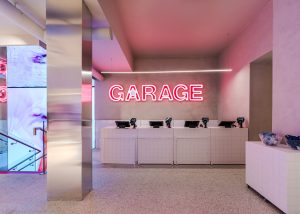
Walking down Oxford Street, it would be hard to miss Garage’s new store.
Despite the drizzling grey London skies, alongside the usual hum of the UK’s busiest high street, rows of shoppers are queuing behind bright pink ropes, waiting for their turn to enter Oxford Street’s latest addition.
Stepping inside the store, the energy only builds. The space is packed with customers picking through rails of loungewear and athleisure in colours including, but not limited to, deep burgundies, rich blues and signature vibrant pinks. Further in the store, a steady line forms along the mirror-lined staircase, where shoppers wait for changing rooms and the in-store embroidery station.
Garage has come to London, and it is clear, with a bang.
While not quite its UK debut (it launched its e-commerce site earlier in the month, before opening its first UK brick-and-mortar doors in Bluewater on 20 March), the opening of the store does mark an important stage of its wider roll-out across the pond.
And at the head of the Montreal-born retailer’s success sits business veteran and CEO of 40 years Andrew Lufty.
Retail Gazette caught up with Lufty during Garage’s Oxford street opening to talk about its UK debut, capturing the y2k movement and the importance of supply chain.

Stepping into Garage’s new Oxford Street store, the brand’s proposition is immediate: open, energetic, and distinctly Gen Z. For Andrew Lutfy, the man behind the Canadian retailer’s UK push, the concept can be summed up in a single word.
“Unapologetic,” he says. “Happy. Good energy. Movement, dance… girls for girls.”
It’s a simple articulation of a business that has, in reality, been decades in the making.
The evolution of the Garage brand
Founded in 1975, Lutfy has been leading the business for more than 40 years, having joined when Garage was a small, little-known denim and sweater shop operating out of an “obscure shopping centre” in Montreal.
The inflection point came in the early 2000s.
“Around 2003 we basically took control of the brand,” he says. “We stopped buying collections and started designing our own, with a real focus on our customer.”
That shift, from buying product to owning design, marked the transition from retailer to vertically controlled brand. It also coincided with a clear idea of who that customer was.
Today, she is “Alex”: 24, university-educated, wellness-focused, and dressed for a lifestyle that moves fluidly between Pilates, coffee runs and socialising. The brand, Lutfy says, has evolved alongside her.
“We follow our customer,” he explains. “Wellness is a huge trend. Movement, dance, life… that releases endorphins. Being a little unapologetic in a healthy way is good for you.”
Why the UK and why now?
After building a business of more than 100 stores across North America, Garage is now testing that model in one of retail’s most competitive markets.
“The UK is a really tough, tough, tough market, especially London,” Lutfy says. “But so is the US.”
His confidence comes from experience. Over the past two decades, the company has expanded both globally and across distinct US regions, from the Northeast to California and Texas, refining its operations and, crucially, its understanding of local customers.

“We’re thriving in every one of those markets,” he says. “We take market share in every one.”
The UK, he argues, shares cultural similarities with the US Northeast, from education to social trends, making it a logical next step. Oxford Street, meanwhile, offers something more.
“It’s on the world stage,” he says. “You meet not only local customers, but international ones. It’s an opportunity to understand where international growth could come from.”
A supply chain built on data not discounting
Where Garage begins to diverge from many UK peers is in how it operates behind the scenes.
The business runs on a tightly controlled model of real-time data, curated assortments and rapid inventory decisions.
“We’re reading customer data in real time, at every location,” Lutfy says. “Based on that, we curate and personalise the assortment for each store.”
At Oxford Street, that means roughly 70% of the broader collection is stocked, with performance monitored and adjusted continuously. What sells in one location may not in another, but the system adapts quickly.
“We push assortments on a daily basis… and then we’re course correcting along the way.”
This approach underpins a striking claim in a market defined by markdowns. “We have the highest full-price sell-through rate of any brand,” he says. “We have virtually no markdowns.”
Short, limited end-of-season sales exist, but the model is designed to avoid the heavy discounting that characterises much of UK retail. “We have the privilege of selling at regular price,” he adds.
And this model is increasingly driven by technology.
“We leverage AI, demand forecasting… we’re reading customer data in real time,” Lutfy says. “We are part art, but a large part science and engineering.”
“The beauty of the model is even from a sustainability standpoint – one of the biggest wastes [in retail] is when something winds up in a landfill,.
“We do not, by the way, consider ourselves fast fashion. Far from it. Our prices are more expensive than SheIn, the quality is epic. But the beauty of our model is that nothing ever winds up in a in a landfill.”
That capability has evolved significantly over time. Lutfy himself started his retail career in the stockroom, and still describes a focus on operational detail and constant improvement.
“Today we’re trying to leverage AI in every part of our operations,” he says.
For now, the UK sits firmly within Garage’s existing infrastructure. Production is handled overseas, primarily in Asia, with goods flowing through North America before reaching the UK.
“Everything kind of comes from North America, and then from North America comes over here,” Lutfy says.
And so despite wider geopolitical pressures, such as the Middle East war, he says the impact on the business has so far been minimal, with only limited exposure to rising transport costs.
As for the future, exciting things lie in the horizon for Garage. With five UK stores already committed – including an expansion into Manchester with launches in Manchester Arndale and Trafford Centre in 2026 – and early trading described as strong, Garage is approaching the market as both an expansion and a test case.
The data gathered from its first locations will play a central role in determining how quickly it scales across the UK and where it goes next globally.
Click here to sign up to Retail Gazette‘s free daily email newsletter