March marked a significant moment for Crocs in the UK. For the first time in its history, the brand opened a full-price UK store, taking 1,500 sq ft at Westfield Stratford City in east London.
More than simply another store opening, the launch is a deliberate push from Crocs to meet customers in the real world, not just online. As retailers continue to rethink the purpose of physical stores, Crocs is positioning Stratford as a place for discovery, personalisation and brand connection.
The opening also forms part of a wider international growth push. Crocs Inc chief executive Andrew Rees recently announced that international revenues, which now make up almost half of Crocs brand sales, grew 11 per cent in fiscal 2025, following 19 per cent growth the year before.
Rees has said the Crocs brand will be “bigger internationally than it is in the US” in 2026, with the company planning to open between 200 and 250 doors across key markets and distributor territories globally.
For Adrian Holloway, senior vice president and general manager of EMEA at Crocs, the UK store is part of that next phase. Holloway, who has been with the business for more than 14 years, says Stratford has been designed to deliver something ecommerce cannot.
“As the first UK full-price store, we want the Stratford store to provide a reliable, everyday Crocs experience that educates consumers and builds lasting brand love,” he says.
“In today’s dynamic marketplace, global retail store concepts are evolving from transactional spaces to immersive brand experiences. In a world where everything can be bought online, stores should offer what the internet can’t, human connection and a story worth stepping into.”
That idea is the core theme in Crocs’ renewed retail strategy. The brand has never lacked recognisability. Its Classic Clog has moved from practical footwear to cult object, fashion statement and collaboration canvas. But translating that energy into a physical store requires more than shelves of brightly coloured shoes.
The Stratford store showcases Crocs’ adult and children’s footwear and accessories collections, from Classic Clogs and sandals to seasonal ranges, collaborations and Jibbitz charms. It also features a refreshed layout, designed to highlight core and seasonal colourways through bold displays and fixtures.
Designing around the customer
For Holloway, however, the starting point is not the product. It is the customer.
“Like most of everything at Crocs, it all starts with our customers,” he says. “Whether online or in person, we are constantly thinking about the customer and putting them first. We design our stores around how our customers interact with our brand — like our interactive Jibbitz charm bars to encourage everyone to express themselves through their shoes.”
That focus on self-expression has become one of Crocs’ defining strengths. Jibbitz charms, first introduced in 2006, have helped turn a functional product into a chance for shoppers to make a statement. In store, they also give customers a reason to linger, experiment and create.
“Personalisation is a major consumer trend, and we have been leading the way in the footwear category since introducing Jibbitz charms to the world all the way back in 2006, the original way to personalise our shoes,” Holloway says.
“Jibbitz charms are a pivotal piece of our personalisation strategy, enabling us to create culturally relevant and hyper-local accessories for our fans. We empower consumers to imagine amazing ideas and bring them to life with the use of Jibbitz charms.”
The charm bars also allow Crocs to adapt its stores to local audiences without losing brand consistency.
“Whilst our key product focuses remain the same across the UK, our personalisation strategy with Jibbitz charms allow us to engage with regional audiences,” Holloway says. “For example, we have local sports team Jibbitz, country flags, food theme Jibbitz and also phrases which allow us to adapt in any region.”
 Different formats, same brand energy
The Stratford opening follows Crocs’ launch at Caledonia Park in Scotland, an outlet location with a different customer mission and commercial role. For Holloway, the challenge is adapting the experience to different shopping mindsets while keeping the brand recognisable.
“The Crocs outlet locations maximise value on both sides of the transaction, offering deal-seeking shoppers the Crocs they love at feel-good prices, while driving efficient business performance,” he says.
“The Westfield Stratford City store offers a much more immersive experience with Jibbitz charms stations, exclusive collab products and brand-new collections.”
In both formats, Holloway says store colleagues are central to how the brand comes to life.
“We have tremendous retail teams in all of our stores, whether outlet or mainline, who are passionate about our brand and serving our customers,” he says. “Our retail employees are often the first touch point a consumer has with our brand, and ours make a great first impression.”
That role has become more important as physical retail shifts further away from pure transaction. Customers may arrive having already seen a collaboration, product drop or social media moment online, but the store team can turn that interest into a fuller brand experience.
“Our Crocs retail employees are an incredibly important component of how we show up for consumers,” Holloway says. “Often, these employees are customers’ first experience with Crocs.
“Our retail employees around the world, and here in the UK, are incredible stewards of our brand. We have robust training and development plans for our retail employees to fully immerse them in the brand so that they can best serve our customers.”
Bringing collaborations into store
Crocs’ recent success has been fuelled in part by collaborations that have kept the brand culturally visible, from fashion and entertainment partnerships to its latest link-up with Lego. For the Stratford launch, Crocs brought that collaboration into the store through an exclusive Lego installation.
More then just hype-builders, Holloway says that these partnerships are about finding brands and communities that reflect Crocs’ values. “Collaborations and partnerships are an important component of our product strategy because they allow us to authentically connect with new consumers,” he says.
“We only partner with people, companies and brands that share our same values of individuality, inclusiveness and self-expression.” Stores, he adds, give Crocs a way to make those moments more 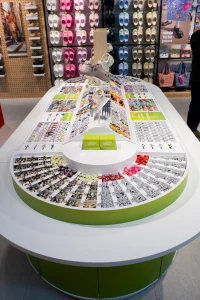 tangible.
“Stores are a great way to bring our collabs to life. For the launch of Stratford, we created an exclusive Lego installation to excite customers and to showcase the brand-new collaboration.”
This is where physical retail still has an edge. Crocs can sell online, launch collaborations digitally and build excitement through social platforms. But the store gives customers a chance to try, customise, interact and feel part of the brand.
“Retail stores are a place for a brand to really speak to their customers and offer them exciting experiences that online can’t,” Holloway says.
“Consumers can immerse themselves in the brand, try on products and most importantly personalise them before purchase at our Jibbitz stands.
“In this digital age, many consumers are yearning for and seeking out in-person, physical connections with the brands they love. Our retail stores are some of the fullest representations of our brand and what it stands for.”
What success looks like
At a time when rising costs, fragile confidence and online shopping continue to challenge store economics, new openings need to work harder. For Crocs, success is measured through both hard performance and softer indicators of brand engagement.
“Sales and foot traffic are of course important indicators for any retail store,” Holloway says. “We also take a closer look at our customers, how they interact with the store and how they resonate with our brand.
“This is less tangible than some other metrics, but when you spend some time in a store you can really feel it come to life as customers excitedly sort through new product to find their size or spend time at the Jibbitz charm bar to make a shoe that is uniquely them.”
“Opening our first full-price Crocs store in the UK marks the latest phase of our 2026 retail strategy aimed at scaling the brand in the most strategically important European markets,” Holloway says.
“The Westfield Stratford City store is a physical touchpoint for consumers and will drive global brand heat and engagement through the main collections as well as strategic collaborations including our latest partnership with the Lego Group.
“This fabulous new Crocs store will also help us to continue connecting directly with our passionate communities of customers.”
For a company that has transformed from comfort footwear outsider to one of fashion’s most recognisable brand stories, Stratford signals confidence in the continued power of stores.
“Retail is and remains a key component of our overall Crocs brand strategy as we continue to open new stores in key markets around the world,” Holloway adds. “Physical retail is still incredibly important to how customers interact with and perceive our brand.”
The Stratford store isn’t trying to compete with online convenience. It’s trying to offer something different, wether that be colour, play, personalisation, collaboration and community, under one roof.
As Holloway puts it, in a world where almost anything can be bought online, stores need to give shoppers “a story worth stepping into”.
Click here to sign up to Retail Gazette‘s free daily email newsletter