The Dalhousie University Agri-Food Analytics Lab’s annual Top 10 Food Stories is now out, offering a snapshot of the issues that shaped Canada’s food landscape in 2025. This year’s ranking moves beyond headlines to focus on the structural forces influencing food affordability, trust, and system resilience. While some stories captured public attention through symbolism and nostalgia, others exposed deeper economic and regulatory fault lines that will continue to shape Canada’s food system well beyond 2025.
Top Food Stories of 2025 — Ranked (10 → 1)
10. Crown Royal Theatrics
Optics over outcomes.
Crown Royal became a surprisingly visible food-and-drink story in 2025 after Ontario Premier Doug Ford made a public display of “dumping” the whisky as part of a broader patriotic posture. The moment generated heavy media coverage and social media traction, but it obscured more than it revealed. What was largely overlooked is that Diageo, Crown Royal’s owner, continues to produce the whisky in Canada, with distillation operations remaining in Manitoba and Quebec, despite the closure of an Ontario bottling plant. The episode illustrated how easily political symbolism can crowd out economic facts. In substance, the Crown Royal moment did little to alter supply chains, prices, or employment trends. It was cultural PR—entertaining, highly visible, but marginal in terms of systemic food or beverage policy impact.

9. Disappearance of Iconic Candies (Cherry Blossom, Jersey Milk)
A cultural story driven by hard economics.
The disappearance of legacy confections such as Cherry Blossom and Jersey Milk became one of 2025’s most emotionally resonant food stories. What initially appeared to be routine brand rationalization quickly turned into a national nostalgia moment, amplified by viral social media reactions. Beneath the sentimentality, however, were unmistakable economic pressures: rising cocoa and sugar costs, higher energy and labour expenses, declining per-unit margins, and relentless competition for shelf space in a high-velocity retail environment. The backlash revealed how deeply food brands are embedded in collective memory—but also how unforgiving modern food economics has become. In 2025, heritage alone proved insufficient to survive.
8. Buy Canadian & Maplewashing
A credibility test for brands and policymakers.
“Buy Canadian” emerged in 2025 as both a rallying cry and a stress test for consumer trust. Politicians and grocers leaned heavily on patriotic cues—flags on packaging, expansive “local” claims, and national branding—often without meaningful changes in sourcing or ownership. Consumers responded with skepticism. Many began asking harder questions about what “Canadian” truly means when ingredients, processing, and corporate control span borders. This triggered a backlash against Maplewashing: the use of national symbolism without substantive domestic economic value. Brands able to demonstrate real Canadian production, processing, and contribution benefited; those relying on vague nationalism faced pushback. What started as marketing evolved into a broader reckoning about transparency, authenticity, and credibility in food branding.
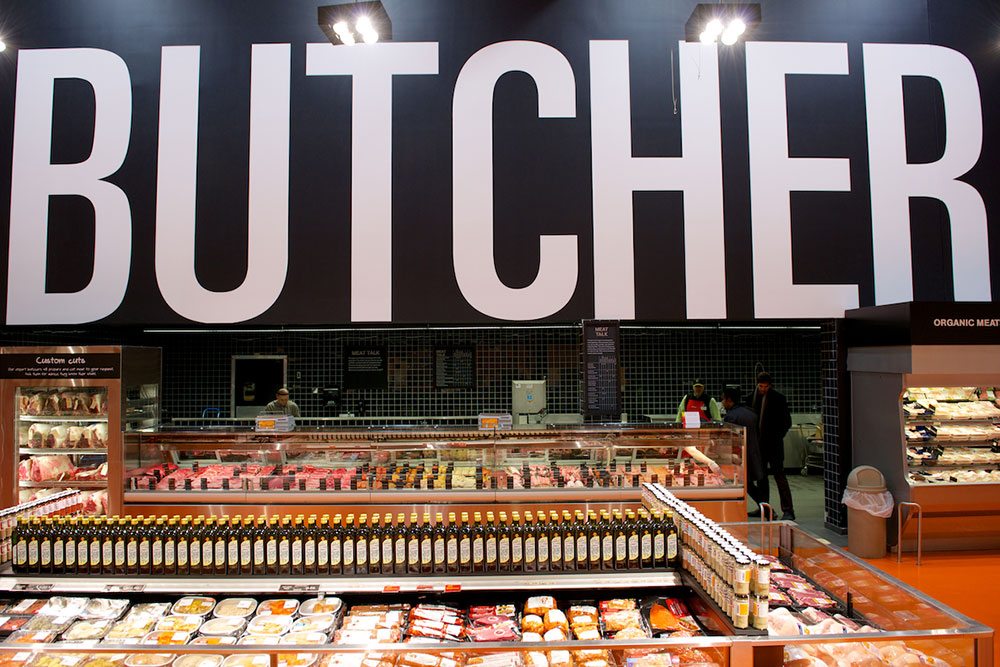
7. Meat Counter Economics
Record prices, tight supply, and uncomfortable realities.
Meat prices—particularly beef—reached record highs in 2025, with little expectation of normalization before 2027. Drought conditions pushed ranchers to liquidate herds, but unlike previous cycles, herd rebuilding stalled due to credit constraints, interest rates, and market uncertainty. Consumers increasingly shifted toward chicken, just as supply tightened. Despite supply management’s promise of domestic balance, Canada imported millions of kilograms of chicken from the United States, a reality largely absent from mainstream coverage. Pork prices also trended upward. The meat counter became a visible reminder that production systems, policy frameworks, and consumer demand are increasingly misaligned.
6. GST Holiday and the Debate on Making It Permanent
Reopening a fundamental policy question.
The anniversary of the GST Holiday in 2025 reignited the national debate over taxing food. Many Canadians forget that the year began with negative food inflation (-0.6%), largely attributable to the temporary removal of GST on prepared foods. By year’s end, food inflation exceeded 3.4%, surpassing the U.S. despite intense tariff pressures there. The temporary tax relief raised a simple but powerful question: why does Canada tax food at all? Globally, many jurisdictions do not. In Canada, consumers pay an estimated $2 billion annually in grocery sales taxes and over $5 billion in foodservice. While the GST Holiday was short-lived, it permanently shifted public expectations and policy discourse.
5. GLP-1s Transforming Food Demand
A quiet structural shock to consumption.
GLP-1 drugs such as Ozempic became one of the most consequential, if understated, food stories of 2025. An estimated two million Canadians now use GLP-1s primarily for weight loss—roughly the combined populations of Manitoba and New Brunswick. Regardless of public-health debates, the market effects were immediate: reduced demand for snacks, confectionery, alcohol, and some foodservice categories. The number of Canadians using GLP-1s for weight loss rose approximately 80% in one year. For food manufacturers and retailers, 2025 marked the moment when GLP-1s shifted from curiosity to structural demand disruptor.
4. The Cloned Meat Disaster
A regulatory and communications failure.
One of the year’s most emotionally charged food stories stemmed from Health Canada’s handling of meat derived from the offspring of cloned animals. The agency was preparing to classify such products as non-novel, allowing commercialization without labelling or proactive public disclosure. When the approval process was abruptly paused, it became clear that no public communication strategy existed. Social media reacted first; national media followed. For the first time in years, Canadians rejected a food technology not on scientific grounds alone, but due to opacity and perceived regulatory arrogance. The episode underscored a new reality: consumer trust can no longer be assumed, and transparency is now a core regulatory function.
3. Tariffs and Counter-Tariffs Hitting Food Prices
Policy volatility with direct price effects.
Trade tensions dominated 2025, and agri-food was not spared—despite CUSMA. The elimination of the de minimis exemption, increased paperwork, and inconsistent enforcement raised costs throughout the supply chain. As Canadians adjusted to a U.S. administration openly skeptical of global trade, fatigue grew around the unpredictability and politicization of tariffs. Ottawa lifted tariffs on several food products on September 1, with the U.S. following weeks later, but uncertainty persisted—particularly around fertilizers and other key inputs. The year reinforced how quickly trade policy can translate into food price volatility.
2. Grocer Code of Conduct Established (Finally)
A long-awaited structural reform.
After years of delay, 2025 delivered a breakthrough: the Grocery Code of Conduct, set to take effect on January 1, 2026. This represents the most significant structural reform in the Canadian food sector since the 1980s. The code aims to rebalance power between dominant grocers and suppliers, with the longer-term objective of stabilizing food prices. Critics argue the current version resembles a code of ethics more than a binding enforcement tool, but industry hopes it will reduce friction and improve predictability. If the voluntary framework fails, pressure will intensify for mandatory regulation.
1. Structural Food Inflation Crisis
The defining food and economic story of 2025.
Above all else, 2025 was the year Canadians began to understand that food inflation is not a temporary shock. Canadians felt poorer at the grocery store, and political discourse—at last—started to move away from simplistic “greedflation” narratives toward structural causes: logistics inefficiencies, carbon pricing, interprovincial trade barriers, regulatory drag, labour shortages, supply-chain power imbalances, and persistent policy failures. Food insecurity reached historic levels. HungerCount 2025 reported more than two million Canadians using food banks every month, with one in four Canadians food insecure. Crucially, awareness grew that Canada’s food inflation problem began in 2008, following the financial crisis, and never truly corrected. Unlike the U.S., Canada failed to reset. By 2025, the consensus finally emerged: Canada’s food inflation problem is structural, not cyclical—and will not resolve without deep, politically uncomfortable reform.
Honourable Mentions
Talks to End Interprovincial Trade Barriers
Food affordability finally reframed internal trade barriers as an economic issue, not a constitutional abstraction. While progress remains incremental, 2025 marked a notable shift in tone toward regulatory harmonization.
The MAHA Movement
Closely associated with Robert F. Kennedy Jr., the MAHA movement gained influence in select policy and activist circles. While not mainstream, its spillover into Canada showed the country is not immune to ideologically driven skepticism toward food regulation, science, and industrial scale.
More from Retail Insider: