After Lisa Lane pitched her slip-on connector product, Rinseroo, on Shark Tank this January and received the show’s “golden ticket,” she was raring to go, ready to scale and enthused about ordering her products.
Then came heightened tariffs — in February, a 10% increase on imports from China, eventually escalating to a 145% duty rate, but soon dropping to 30%. Lane imports her finished products from China, and the hiked tariffs brought her plans to a halt.
“Just to get it off the boat was like paying for a mortgage,” Lane said.
She quickly worked with her manufacturer to find ways to lower costs. One solution: a change in packaging dimensions that ended up saving 70 cents per unit for every item shipped via Amazon.
Lane’s story is emblematic of a broader trend: Business owners are taking a closer look at packaging to keep costs in check. In fact, many brands and retailers have been auditing their packaging, more so than they did during the first Trump administration. This is because today’s sweeping tariffs impact more countries, according to Michael Nass, executive vice president at Creative Retail Packaging, a packaging distributor.
In addition, packaging costs have risen, with the producer price index for paperboard boxes reaching a record high in July. Altering packaging to cut costs is often easier than changing the product manufacturing itself, Nass added.
How exactly businesses reduce their packaging costs, however, depends on the company.
Shark Tank startup: Shrinking packaging dimensions
Lane’s company makes slip-on hose connectors for showerheads and faucets, so consumers can wash their dog or clean the shower. The hose was packaged in a cardboard box measuring around 8x8x3.3 inches. Because Lane sells through Amazon, where costs are based partly on dimensional weight, the product’s packaging was in the “large standard” tier.
As tariffs were announced, Lane reached out to her vendor to see what was possible in terms of packaging size. The manufacturer sent a sample of the box with the same material and artwork, but shrunken down by an inch on the longer sides — still enough space to accommodate the product. The change qualified the box under Amazon’s “small standard” category, saving shipping costs. In addition, the smaller package used less material, which further lowered costs.
Lane described the process as collaborative, and she touted a strong relationship with her packaging supplier.
“A good manufacturer that wants your business is always willing to work with you,” Lane said. “That’s the goal, to grow together.”
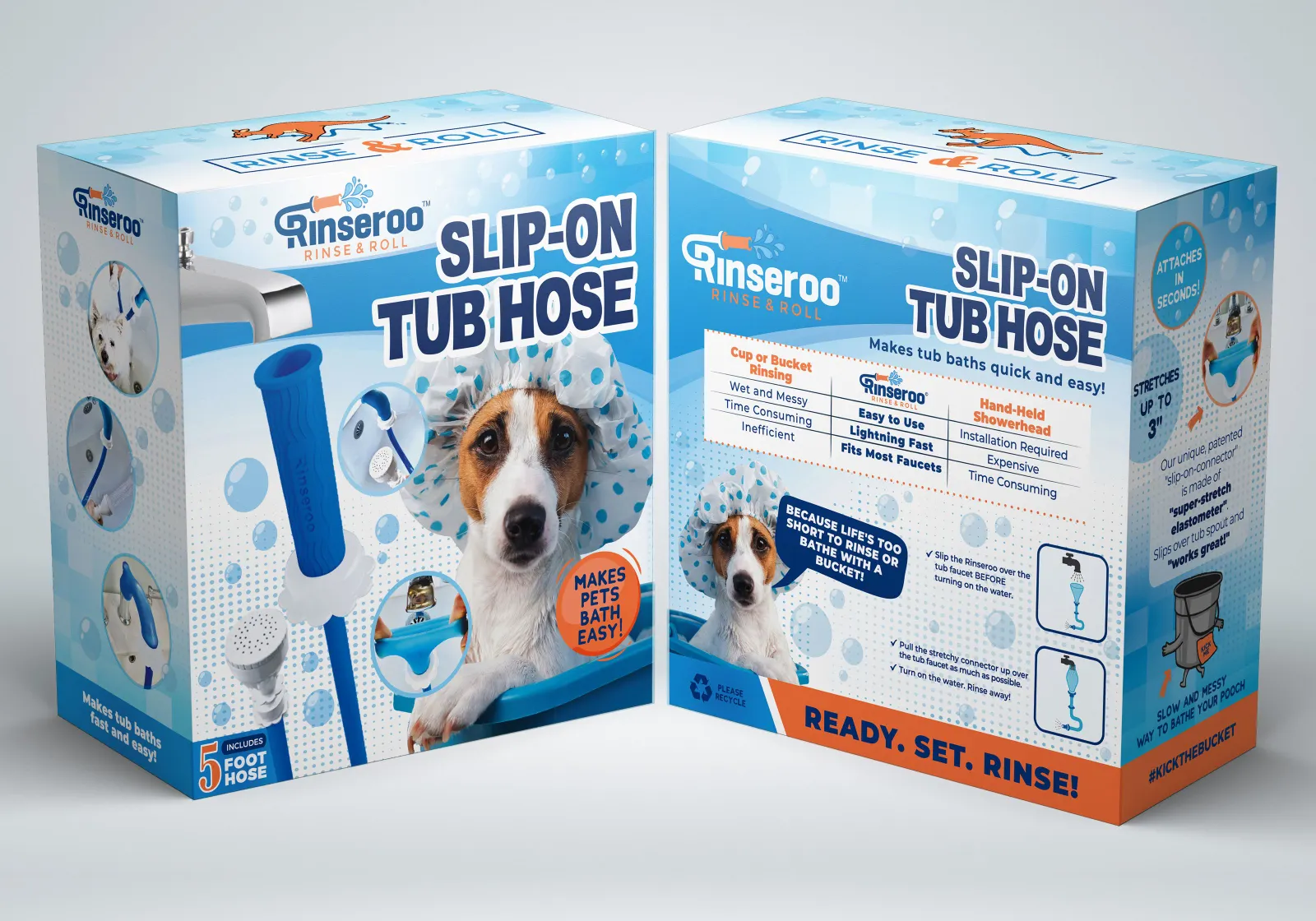
One of the boxes that Rinseroo is making smaller.
Permission granted by Rinseroo
Beauty brand: Frontloading packaging ahead of tariff hikes
Time was a blessing and a curse for Naomi Hung, co-founder of Mochidream, a skincare brand for tweens. The company manufactures and fills in the U.S. but imports packaging from overseas, including boxes from Canada.
Hung placed an order for boxes, the order got delayed, and at that same time, the Trump administration announced tariffs on Canadian imports. She asked her supplier to further delay the shipment while the business figured out what to do.
Within days, the administration paused the tariffs on Canada, and the founders called their box supplier “the second we heard the announcement,” Hung said. “We said, ‘ship everything.’”
Now, Mochidream has packaging inventory to last through the year. But once this year’s inventory runs out, Hung isn’t sure yet what she’ll do going forward. “We are kind of in wait-and-see mode in terms of what to do for the next batch order.”
Negotiating with suppliers is one possibility, but Hung noted it’s difficult for small businesses and emerging brands that can’t always meet minimum order quantities.
Retailer: Changing packaging type and supplier
It’s not just U.S.-based businesses contending with tariff changes. Katie Jones owns a U.K.-based store that sells homewares, handmade jewelry, stationery and other products.
Even though Jones wasn’t directly caught in the U.S trade war like her American counterparts, the global nature of supply chains led to higher costs worldwide as materials flowed across borders, and tariffs indirectly raised costs for her suppliers.
Case in point: Jones was importing kraft boxes from China to the U.K. at $1.20 each. Post-tariffs, the cost shot up to $1.75 per box – or $1,100 in packaging costs on a single delivery.
“In the case of a small retail business such as mine, that was too much of a margin to give up,” said Jones, who owns the Squirrel A Store of Buried Treasure shop in Ulverston.
She switched from kraft boxes to plain corrugated boxes from a U.S.-based supplier, bringing costs down to 85 cents per box. For an additional 10 cents, she adds her own branded tissues and “an uncomplicated sticker.”
The changeover, however, wasn’t easy.
“It seemed like attempting to find a needle in a haystack to find someone locally who would be able to fulfill small and large order quantities,” Jones said.
She spent hours emailing prospective suppliers, reviewing samples, comparing costs, and considering factors like durability and print quality, and it took three months to change suppliers. She also had to change her minimum order quantity and alter storage space, because the new supplier’s cartons were slightly larger than the previous supplier’s.
In the end, Jones said the hassle was worth the savings, and the new packaging highlights what’s important to her business: the product inside.
Tariffs: Just one piece of the packaging puzzle
As companies mull potential packaging changes, tariffs are just “a part of the equation” that also factors in total cost, functionality and sustainability, Nass said.
“You have to consider your brand image,” Nass said. “Your packaging is part of your clients’ experience.”
The packaging experience was critically important to Mochidream’s Hung, and it’s a big reason she’s not looking to redesign due to tariffs. In the development stage, she and her co-founder spent a lot of time designing packaging that would appeal to their demographic. They created a custom color, selected a heavyweight plastic bottle for a premium feel, and chose plastic droppers, rather than glass ones, to make sure the product packaging was safe for young consumers.
Lane, too, wanted to ensure her smaller boxes didn’t lead to product problems, such as creating a kink in the hose. She also wanted to make sure the smaller packaging didn’t change the perceived quality.
“It still had the same vibe to it, without diminishing the value,” Lane said. “We were happy.”
Tariff mitigation strategies often center on raising prices — but “people will only pay so much for a product,” Lane said — or shifting supply chains to the U.S. to eliminate tariffs, which Nass said can be difficult due to capacity constraints.
Hung said when searching for a dropper for her serum product, “it was almost impossible to find” a packaging supplier that made them from plastic. She eventually found a supplier in Taiwan.
As long as the tariff situation feels fluid, many companies aren’t willing to commit to resource-intensive shifts if there’s a possibility the duties will change again. Hung sees projection and planning as the hardest aspect. When she initially was developing her product, she assessed costs and suppliers based on the tariffs in place at the time under the Biden administration.
Nass agreed that uncertainty around tariffs makes it challenging for businesses to decide on their next move.
“There’s always that concern that you make a shift, and then what’s going to happen a year from now?” Nass said.